Dog Food and Gut Health: What a Husky's Diet Should Cover
General nutrition information compiled from product labels and published sources, not veterinary advice. Your veterinarian is the right person to choose a diet for your dog, especially one with a health condition.
Owners often ask about dog food for gut health as if one bag could settle it. No label can promise that. What you can do is pick a complete diet that fits your Husky's life stage, switch to it slowly, and watch how your dog responds.
This guide walks through that process in order. It uses label data from the brands named below and breed information from the Westminster Kennel Club and the Siberian Husky Club of America. We compared label data only. We did not run feeding trials or taste tests, and nothing here replaces your veterinarian's advice for your own dog.
What You Need Before You Start
- The bag or can of your dog's current food, so you can read the full label.
- Your Husky's current weight and age. Use a recent vet weigh-in if you have one.
- A measuring cup, or better, a kitchen scale. Royal Canin notes that grams are the most accurate way to measure a portion.
- A notebook or phone note for stool quality, appetite and weight.
- Your veterinarian's contact details, for any digestive change that worries you.
For a wider look at breed-specific feeding factors, see the diet factors that matter for this breed.
Step 1: Match the Food to Your Husky's Size and Life Stage
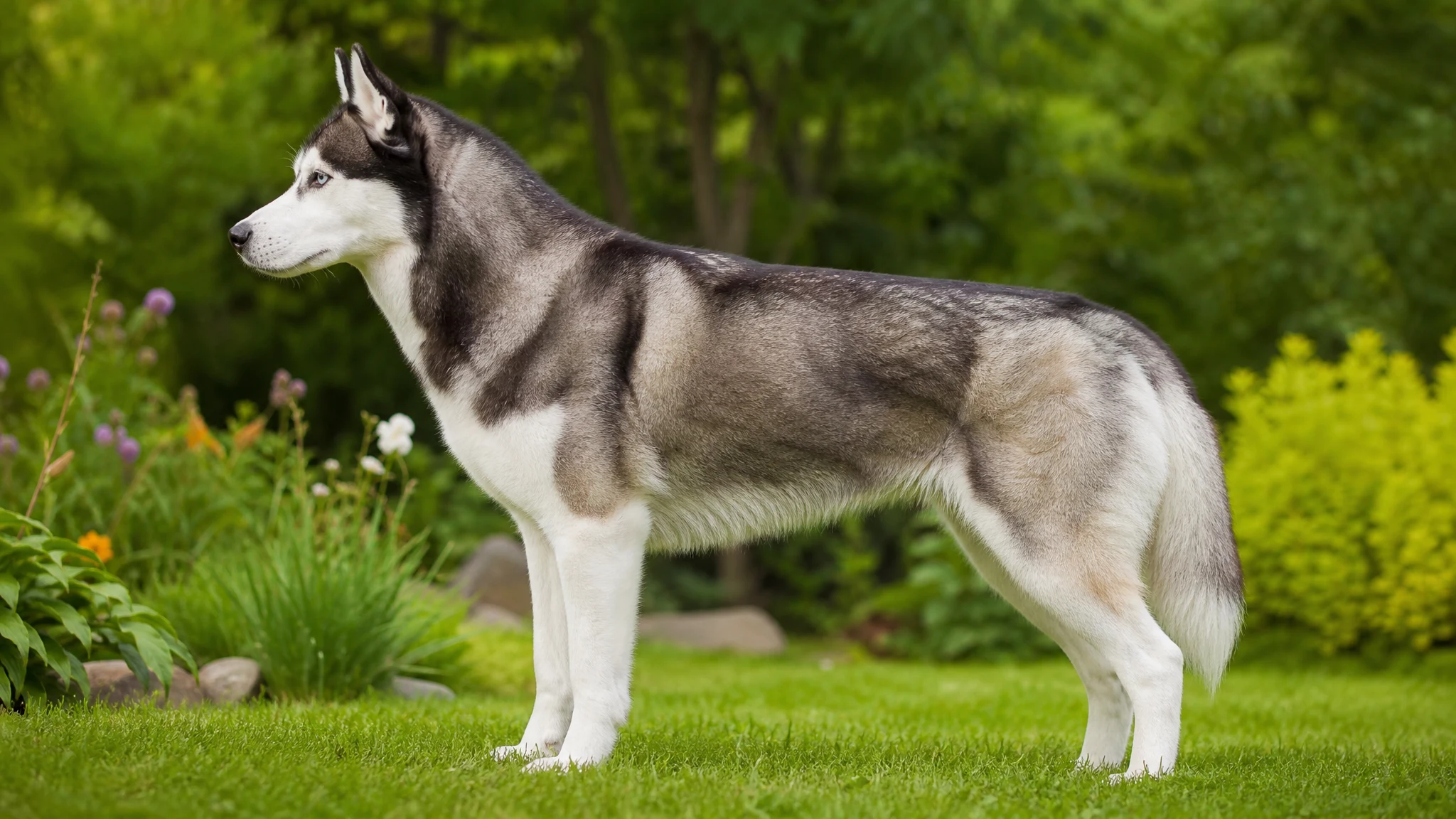
The Westminster Kennel Club lists the Siberian Husky at usually 40 to 50 pounds, with a listed maximum of 60 pounds. That puts most Huskies in the medium range. Brands draw their size lines differently, so check your own dog's weight against each label.
Here is how a few labels word it:
- Royal Canin Medium Adult is for adult dogs of 23 to 55 pounds.
- Royal Canin Large Adult is for adult dogs of 56 to 100 pounds.
- Hill's Science Diet Adult Large Breed lists an ideal weight of 55 to 110 pounds.
A Husky near the top of the breed's weight range may sit between two of these lines. That is a good question to bring to your vet.
Puppies need a growth or all-life-stages food. The AAFCO large-size growth wording refers to dogs of 70 pounds or more as adults, which is above the Westminster maximum for the breed. Whether a large-breed puppy formula suits your Husky puppy is something to settle with your veterinarian. Check with the brand for its own puppy guidance.
Step 2: Find the AAFCO Statement
Look for a sentence saying the food meets the AAFCO Dog Food Nutrient Profiles, or that feeding tests substantiate it. It also names a life stage, such as maintenance, growth or all life stages. This statement tells you the food is meant to be complete and balanced. It says nothing about how a particular dog's gut will react.
Two details are worth noting:
- VICTOR Classic Hi-Pro Plus is labeled for all life stages except growth of large-size dogs (70 pounds or more as an adult).
- Hill's Science Diet states that animal feeding tests using AAFCO procedures substantiate its adult large breed recipe.
Both methods are legitimate ways to support a statement, but they are different. Know which one your food uses.
Step 3: Read the Ingredient List, Not the Front of the Bag
Ingredients are listed by weight, so the first five tell you the most. Marketing words on the front are not regulated the way the AAFCO statement is, so treat them with some skepticism.
Compare what the labels actually say:
| Food | First five ingredients | Energy per cup |
|---|---|---|
| Royal Canin Medium Adult (dry) | Brewers rice, chicken by-product meal, oat groats, wheat, corn protein meal | 340 kcal ME |
| Hill's Science Diet Adult Large Breed Chicken & Barley (dry) | Chicken, cracked pearled barley, brown rice, brewers rice, whole grain wheat | 365 kcal |
| VICTOR Classic Hi-Pro Plus (dry) | Beef meal, grain sorghum, chicken fat, whole grain millet, blood meal | 406 kcal |
| Freshpet Vital Large Breed (fresh, refrigerated) | Chicken, beef, egg, salmon, beef liver | 337 kcal (calculated) |
Calories vary a lot between foods. A cup of VICTOR Classic Hi-Pro Plus carries about 66 more kilocalories than a cup of Royal Canin Medium Adult, going by their own pages. That is why you should never swap one food for another cup for cup.
Some brands do not publish every number. Hill's lists dry matter averages rather than guaranteed minimums for its dry foods, so the figures are not directly comparable with a minimum-protein label. Kibble size is not stated on most of these pages. Check with the brand if that matters for your dog.
Step 4: Keep the Food Question Separate From Medical Claims
Nobody can say a food prevents or treats a condition in an individual dog. Two examples show why that caution matters.
The Siberian Husky Club of America calls canine hip dysplasia inheritable and of utmost concern in the breed. Its page does not link the condition to a specific diet. The club also reports that the Orthopedic Foundation for Animals evaluated 12,087 Huskies from 1994 to 1998, and 2.2% were dysplastic. That figure covers only those years.
On heart disease, the FDA's investigation into a possible link between certain diets and canine dilated cardiomyopathy (DCM) had its latest update on December 23, 2022. The FDA said it did not plan more public updates without meaningful new science. It also said report counts do not establish a causal relationship. If you are weighing grain-free and other diets, ask your vet and check the FDA page for anything newer.
If your Husky has chronic loose stools, vomiting or a suspected allergy, that is a medical question. A prescription diet is something only a veterinarian prescribes.
Step 5: Start With the Label's Feeding Guide
Treat feeding charts as starting points. Royal Canin says its Medium Adult guide is only a guide. Hill's says to adjust amounts to maintain optimal weight and to ask your veterinarian if you are unsure. Nom Nom says its daily recommendations may vary with age, weight and activity level.
Weigh out the portion, split it into two meals if your vet agrees, and count treats as part of the day's food. Adjust slowly, based on your dog's body condition and your vet's input.
Step 6: Switch Foods Gradually
A sudden change is a common reason for an upset stomach. Hill's suggests transitioning its large breed puppy food over 7 days. That is a reasonable template for most switches, though your vet may suggest a different pace.
- Days 1 and 2: mostly the old food with a small share of the new.
- Days 3 and 4: roughly half and half.
- Days 5 and 6: mostly the new food.
- Day 7: the new food only, if stools and appetite look steady.
If stools turn loose or your dog stops eating, go back to the last step that went well and call your vet if it continues.
Step 7: Track What You See
For two to four weeks after a switch, write down:
- Stool consistency and frequency.
- Appetite and energy.
- Any vomiting, gas or itching.
- Weekly weight.
This record helps your veterinarian far more than "he seems off."
Common Mistakes to Avoid
- Changing several things at once. A new food, new treats and a new chew together make it impossible to tell what caused a problem.
- Judging by the front of the bag. Words like "natural" do not replace the AAFCO statement and ingredient list.
- Copying cup amounts between brands. Energy per cup differs widely, as the table shows.
- Feeding a puppy an adult-only food. Check that the statement covers growth or all life stages.
- Adding supplements on your own. Ask your vet first. We give no doses here.
- Assuming fresh or grain-free means better. JustFoodForDogs lists its beef and russet potato recipe for adult maintenance and flags growing puppies as a poor fit. Check the life stage every time.
What You Can Reasonably Expect
A complete diet that suits your dog, introduced slowly, may be followed by steady appetite and well-formed stools. Some dogs adjust within a couple of weeks, and others take longer. A change in food will not necessarily fix a digestive problem, and no brand can promise a result.
If loose stools, vomiting or weight loss last more than a few days, stop experimenting and call your veterinarian.
Sources
- Westminster Kennel Club, Siberian Husky breed page
- Siberian Husky Club of America, Hip Health
- FDA Center for Veterinary Medicine, Investigation into Potential Link Between Certain Diets and Canine DCM
- Royal Canin, Medium Adult Dry
- Royal Canin, Large Adult Dry
- Hill's Science Diet, Adult Large Breed Chicken & Barley
- Hill's Science Diet, Puppy Large Breed
- VICTOR, Classic Hi-Pro Plus
- Freshpet, Vital Large Breed
- Nom Nom, Beef Mash
- JustFoodForDogs, FreshFrozen Beef & Russet Potato