Husky Nutrition: The Diet Factors That Matter for This Breed
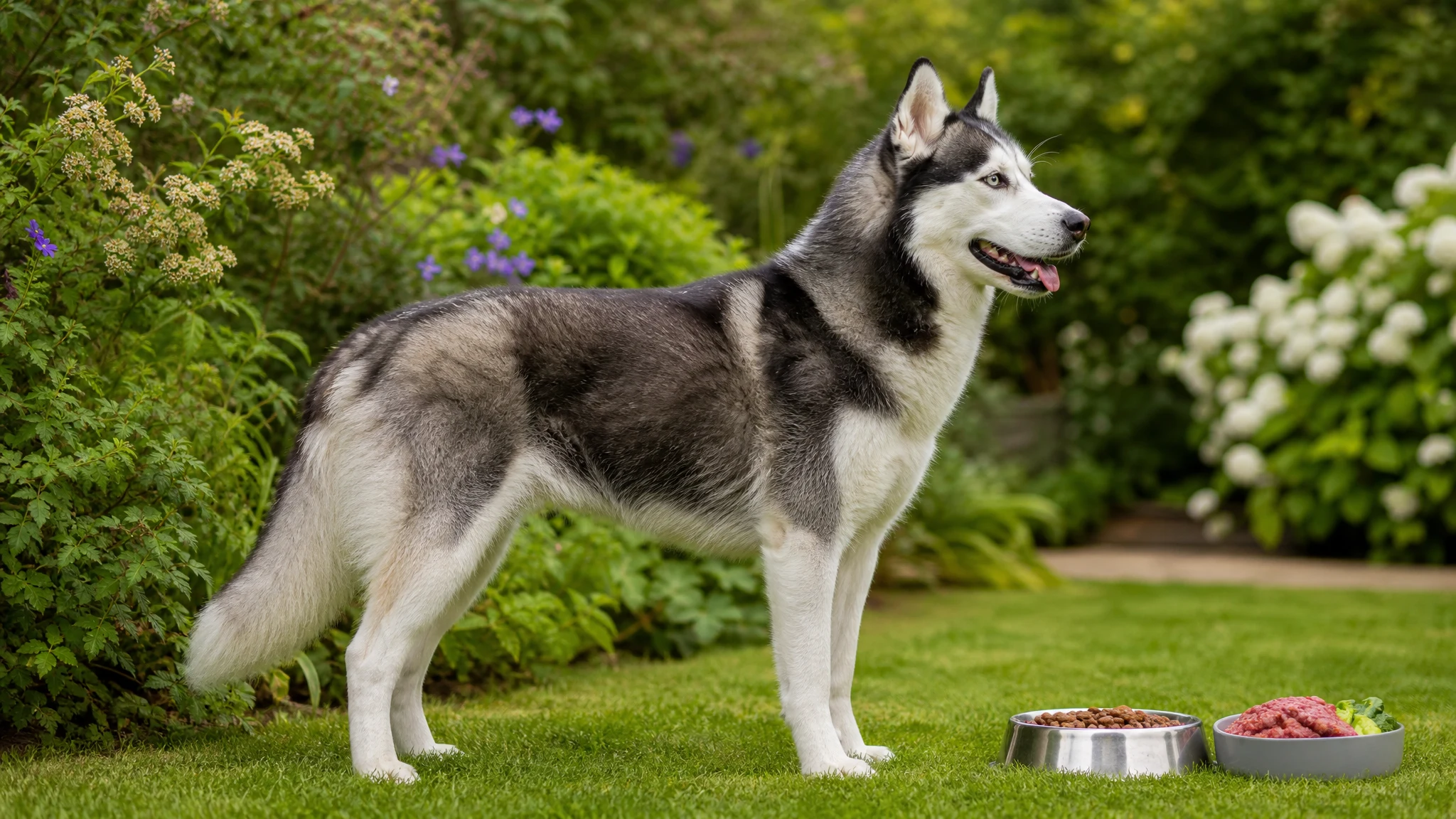
General nutrition information compiled from product labels and published sources, not veterinary advice. Your veterinarian is the right person to choose a diet for your dog, especially one with a health condition.
Husky nutrition is less about finding one magic bag and more about matching a food to one dog. Age, weight, activity and health history all change the answer. This guide walks through that process in order, so you can read a label with confidence and know when to hand the decision to your veterinarian.
A note on method. When we compare foods on this site, we compare label data: the nutritional adequacy statement, ingredients, guaranteed analysis and calories. We have not run feeding trials or taste tests, and nothing here replaces advice from your dog's veterinarian.
What You Need Before You Start
- Your dog's current weight, from a recent vet visit or a home scale.
- Your dog's age, and a rough idea of daily activity (short walks, long runs, sledding, mostly indoors).
- The bag, can or pouch of the food you are considering, or its brand page.
- A measuring cup, or a kitchen scale if the brand gives gram amounts.
- A notebook or phone note for weights, portions and treats.
- Your veterinarian's contact details, for the questions this article cannot settle.
Step 1: Know the Breed Basics
The Westminster Kennel Club describes the Siberian Husky as usually 40 to 50 pounds, with a listed maximum of 60 pounds. It lists a maximum lifespan of 14 years. That puts a typical Husky in the medium-size range, below the 70 pound mark that dog food labels use for "large-size" dogs.
Why does that matter? Many foods are sorted by adult weight. A Husky near 45 pounds sits comfortably inside a "medium" food range, while a very big male near 60 pounds may fall in an overlap between medium and large ranges. Do not pick a bag by the breed's reputation. Pick it by your dog's actual weight and body shape.
One thing we could not confirm from the breed sources is the age at which a Husky counts as an adult, or detailed growth notes for the breed. Ask your veterinarian or the puppy's breeder when to switch from a growth food to an adult food.
Step 2: Match the Food to Life Stage
Every complete dog food carries a statement from the Association of American Feed Control Officials (AAFCO) on the label. It tells you which life stage the food is built for. Read it before anything else on the bag.
- Growth (puppy): formulated for growing dogs.
- Maintenance (adult): formulated for grown dogs.
- All life stages: meant to cover growth and adulthood.
Some statements add a phrase about "growth of large-size dogs (70 pounds or more as an adult)." Whole Dog Journal explains that this wording marks foods meant to cover large puppies. A Husky is expected to finish under 70 pounds, so that phrase is not something the breed strictly needs. It is not a problem if present, either. Some foods carry the opposite exception: VICTOR states that its Classic Hi-Pro Plus meets all life stages "except for growth of large size dogs." That is a reminder to read the full sentence, not just the words "all life stages."
Two other details are worth a look. Some statements say the food meets the AAFCO nutrient profiles. Others say AAFCO feeding tests substantiate it, as Hill's Science Diet does on its adult large breed page. Both are valid ways to back a claim, and they are different methods. Neither one tells you how your own dog will do on the food.
Step 3: Think About Weight and Calorie Density
Weight management is the diet factor that applies to nearly every dog, and a Husky is no exception. Calories are the lever. Two foods can look similar and differ a lot in how much energy fits in one cup.
Here are the per-cup figures from the brands' own pages, for a few dry foods:
| Food (dry) | Calories per cup, per the brand |
|---|---|
| Royal Canin Medium Adult | 340 kcal ME |
| Royal Canin Large Adult | 360 kcal ME |
| Hill's Science Diet Adult Large Breed Chicken & Barley | 365 kcal |
| VICTOR Classic Hi-Pro Plus | 406 kcal |
The spread between the lowest and highest is roughly 20 percent. If you swapped one for another cup for cup, your dog's daily energy intake would change noticeably, even though the scoop looks the same. This is why a feeding amount from an old bag should not simply carry over to a new food.
Fresh foods are harder to compare by the cup. Freshpet lists 337 kcal per cup for its Vital Large Breed recipe, while Nom Nom lists 201 kcal per cup for its Beef Mash. Those foods contain more moisture, so a cup holds fewer calories. Compare calories per day, not cups per day.
How to use the feeding guide
Every brand prints a feeding guide, and the brands themselves call it a starting point. Hill's says to adjust amounts as necessary to maintain optimal weight, and to ask your veterinarian if you are unsure. Nom Nom says its daily recommendations may vary with age, weight and activity level. Royal Canin's Medium Adult page notes that grams are more accurate than cups.
So treat the chart as a first week's portion, then adjust based on your dog's body condition and your vet's advice.
Step 4: Read the Label Numbers Carefully
The guaranteed analysis lists minimum protein and fat and maximum fiber and moisture. These numbers are as-fed, which means they include water. That makes dry food and wet food hard to compare directly.
Some brands also publish dry matter averages instead. The Hill's Science Diet large breed pages, for example, give dry matter averages rather than guaranteed minimums. Do not set a dry matter figure beside an as-fed figure and call one higher. They are measured on different bases.
Next, the ingredient list. Ingredients appear in order of weight before cooking. Fresh meat is heavy with water, so a food that lists chicken first can be less meat-heavy than it looks once the water cooks off. A meal, such as chicken by-product meal or chicken meal, is already dried. Neither is automatically better or worse. They are different forms.
Be wary of marketing words. "Premium," "natural" and "ancestral" are not nutrition measures. The adequacy statement, the ingredients and the calories are.
Step 5: Handle Health Questions the Right Way
Owners often ask whether a certain food helps with a certain condition. The honest answer is that a food does not prevent, treat or cure disease. What we can do is report what the sources say about diet, and say plainly when they say nothing.
Hip dysplasia
The Siberian Husky Club of America regards canine hip dysplasia as inheritable and of utmost concern in the breed. On its hip health page, the club reports that the Orthopedic Foundation for Animals (OFA) evaluated 12,087 Huskies from 1994 to 1998, and 2.2 percent were dysplastic. That figure covers only those years.
That page does not tie the condition to any particular food or nutrient. So we will not either. Keeping a dog at a healthy weight is a common part of veterinary advice for joints, but if your dog has a hip concern, your veterinarian decides what diet and care make sense.
Heart disease and the FDA's investigation
The U.S. Food and Drug Administration (FDA) has investigated a potential link between certain diets and canine dilated cardiomyopathy (DCM). Its most recent update on the page we reviewed is dated December 23, 2022. The FDA said it does not intend to release further public updates until there is meaningful new scientific information, and that report counts do not establish a causal relationship.
We did not check for anything newer than that page. If this topic matters for your dog, read the FDA's page directly and ask your veterinarian. All of the foods mentioned in this article are listed as not grain-free on their brand pages, except JustFoodForDogs Beef & Russet Potato, which the brand lists as grain-free. We are not saying that detail is good or bad. It is label data.
Other conditions
For any other health issue, such as allergies, skin problems or digestive upset, the sources we reviewed give no breed-specific diet guidance. Prescription diets are something only a veterinarian prescribes. Do not try to copy one with an over-the-counter food.
Step 6: Narrow Down the Options
With the steps above in hand, build a short list.
- Filter by life stage statement: growth for puppies, maintenance or all life stages for adults.
- Filter by size range. A 45 pound Husky fits a 23 to 55 pound range such as Royal Canin Medium Adult. A heavier Husky may be closer to a 56 to 100 pound range such as Royal Canin Large Adult. If your dog is near the line, ask your vet which range suits their body condition.
- Compare calories per cup, or per day for fresh foods.
- Check the ingredient list for anything your veterinarian has told you to avoid.
- Visit the brand's own page for the current label, since formulas can change.
We did not find a Husky-specific formula from the brands we looked at, so size and life stage are the practical filters. For a side-by-side look at specific products and their label data, see the best dog food for Huskies, compared label by label.
Step 7: Switch Foods Gradually
Hill's suggests a transition over 7 days on its large breed puppy page, and that is a sensible pattern for any change. Mix a little of the new food into the old, and shift the ratio each day. Watch stool quality, appetite and energy. If something seems off, pause and call your veterinarian.
Step 8: Track and Adjust
Weigh your dog every few weeks at first. Run your hands along the ribs: you should be able to feel them without pressing hard, and see a waist from above. Write down the weight, the daily portion and any treats.
Treats count. A handful of training treats can add up over a day, and a bag of kibble does not account for them. If your dog is gaining, the fix is often a small portion change, made with your vet's guidance, rather than a different food.
Tips
- Measure every meal. "A scoop" drifts over time.
- Use the same cup each day, or better, a kitchen scale.
- Check the date and the full adequacy statement when you open a new bag.
- Keep fresh water available, especially with dry food.
- Ask your breeder or veterinarian for a target adult weight, then feed toward it.
Common Mistakes to Avoid
- Feeding by breed reputation. A Husky's body condition matters more than the idea of a working dog needing endless calories.
- Copying the portion from the old food. Calorie density varies from one food to the next, as the table above shows.
- Using an "all life stages except large-size growth" food for a large-breed puppy. Read the full sentence.
- Treating the label chart as a rule. Brands call it a guide and a place to start.
- Expecting a food to fix a health problem. Diet is one part of care, and your veterinarian guides the rest.
- Changing foods suddenly. Gradual switches are gentler.
What Results to Expect
If the food suits your dog and the portions are right, you may notice steady energy, regular stools and a stable weight over several weeks. Body condition can improve gradually when intake is matched to need, though results vary from dog to dog, and no food can promise a particular outcome. If your dog shows ongoing digestive upset, itching, weight change or low energy, talk with your veterinarian rather than switching foods repeatedly.
Sources
- Westminster Kennel Club, Siberian Husky breed page
- Siberian Husky Club of America, Hip Health
- FDA Center for Veterinary Medicine, Investigation into Potential Link Between Certain Diets and Canine DCM
- Whole Dog Journal, In the Fine Print: Nutritional Adequacy Statements
- Royal Canin, Medium Adult Dry
- Royal Canin, Large Adult Dry
- Hill's Science Diet, Adult Large Breed Chicken & Barley
- Hill's Science Diet, Puppy Large Breed Chicken & Brown Rice
- VICTOR, Classic Hi-Pro Plus
- Freshpet, Vital Large Breed recipe
- Nom Nom, Beef Mash