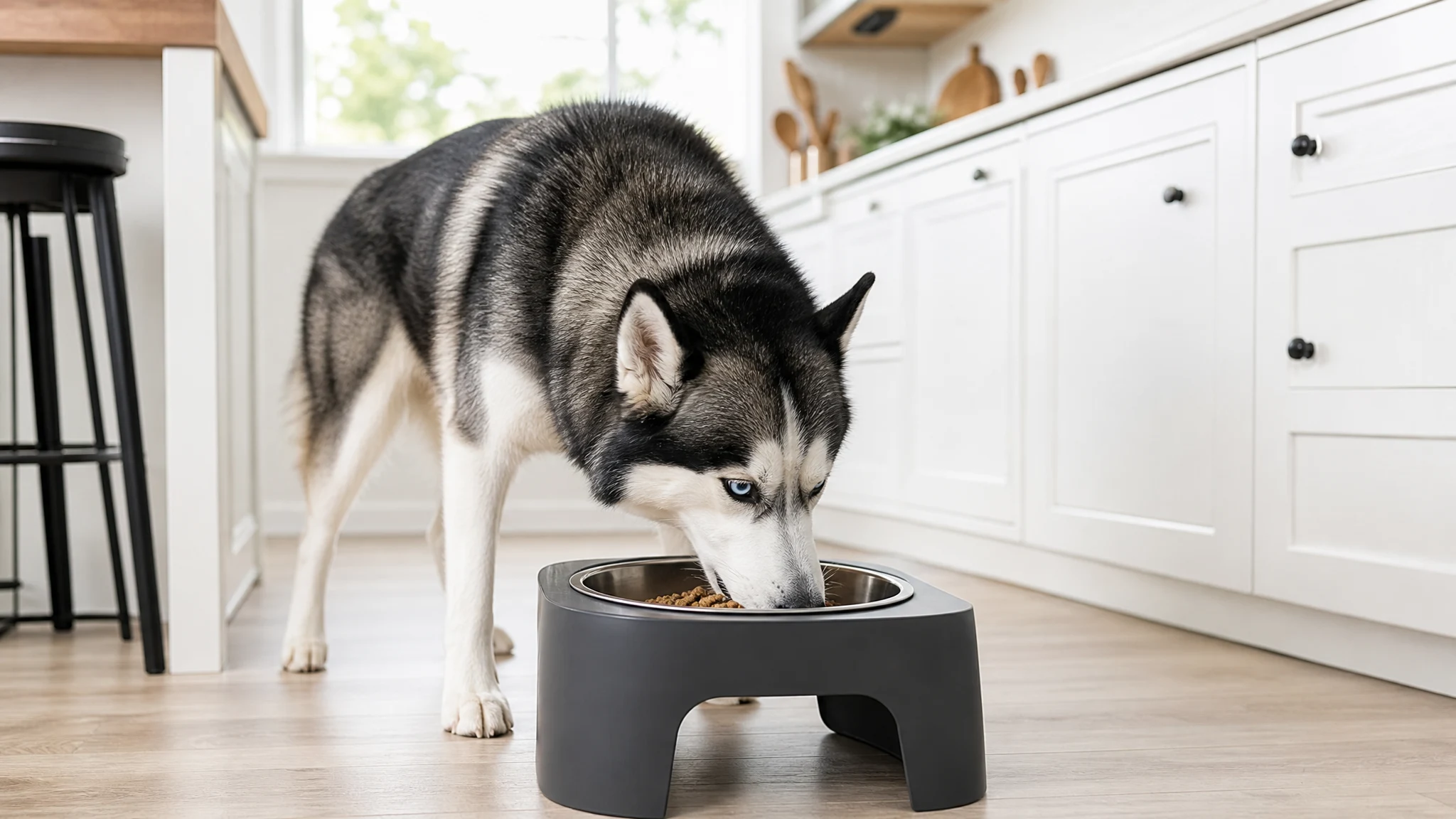
Elevated vs Floor Feeding for Huskies: Does It Matter?
General nutrition information compiled from product labels and published sources, not veterinary advice. Your veterinarian is the right person to choose a diet for your dog, especially one with a health condition.
Raised bowls are sold with big promises. Floor bowls cost nothing and have worked for generations of dogs. So which is better for a Siberian Husky?
Short answer: we found no source in our research that shows raised bowls are needed for a typical, healthy Husky. Bowl height is a comfort and mess-control choice for most households. It is not a substitute for good food, measured portions or a vet's advice.
This guide shows you how to build a simple dog feeding station, compare both heights with your own dog, and decide what to keep.
What the claims say, and what we can back up
You will see claims that raised bowls prevent bloat, help digestion or protect joints. We did not find a source in our research that supports those claims for Huskies, so we will not repeat them. Bloat, joint problems and digestion are medical topics. A veterinarian decides what is right for an individual dog.
The Siberian Husky Club of America considers hip dysplasia an inheritable condition of utmost concern in the breed. Its hip health page does not say that bowl height affects it. If your dog has joint, throat, stomach or mobility concerns, ask your vet about bowl height before you change anything.
Treat any food or feeder that claims to prevent or fix a disease with skepticism. Labels and feeder packaging can say a lot. Check what is actually backed by a source.
Where a Husky fits
The Westminster Kennel Club lists the Siberian Husky as usually 40 to 50 pounds, with a listed maximum of 60 pounds. That is a medium dog. No source we used states a standard bowl height for the breed, so you will set the height by measuring your own dog.
Huskies are also known as clever, food-motivated escape artists. That matters for a feeding station. Light bowls get flipped, dragged and carried off. A heavy bowl or a stable stand is often more useful than a fancy height.
Materials you need
- Two bowls, one for food and one for water. Stainless steel or ceramic are easy to wash.
- A non-slip mat or tray to catch spills.
- An elevated stand with adjustable height, or a sturdy box or step you already own, if you want to test a raised position.
- A tape measure.
- A kitchen scale or a level measuring cup. Weighing is more consistent than scooping.
- Your dog's food label or feeding guide.
- A notebook or phone notes to record what you see.
Step-by-step: set up and compare both heights
Step 1: Check with your vet first if there is a health issue
If your Husky has a history of stomach trouble, swallowing problems, arthritis, neck or back pain, or you are unsure, ask your veterinarian before testing a raised bowl. Confirm food amounts with them too. If your dog is healthy, you can go on to Step 2.
Step 2: Pick a calm, stable spot
Choose a quiet corner on a floor that does not slip. Avoid walkways where people step over the bowls. Put the non-slip mat down first. A Husky that feels crowded may gulp or guard, so give the dog room.
Step 3: Measure your dog
Have your dog stand relaxed. Measure from the floor to the point of the shoulder, or the base of the chest. A common rule of thumb is that the bowl rim sits at about lower-chest height, so the dog does not have to stretch up or crouch down. This is a general comfort guideline, not a breed standard. Adjust it to what looks natural for your dog.
Step 4: Start with the floor bowl
Begin with a heavy bowl on the mat. Watch for a week or so. Note how fast your Husky eats, whether the bowl slides, how much food ends up on the floor, and whether the dog seems comfortable. The floor is a natural position for most dogs, so it makes a good baseline.
Step 5: Measure the meal the same way every time
Use the same scale or cup every meal so you are comparing heights, not portions. For amounts, start with the label guide on your food and treat it as a starting point. Brands base their guides on a dog's adult weight and activity level. For example, Royal Canin's Medium Adult dry food is labeled for adult dogs of 23 to 55 pounds and lists 340 kcal ME per cup, as fed, calculated. That is one brand's figure and will not match every food.
Weight, age and activity change the right amount, and the label is only a guide. Our Husky feeding chart by age and weight explains how to work from these starting points. Adjust based on body condition, and confirm amounts with your vet if your dog has a health condition.
Step 6: Try the raised position
After the baseline week, set the food bowl in the raised stand at the height from Step 3. Keep the same food, the same amount and the same mat. Let your dog sniff the stand first and eat at its own pace. Offer a few kibbles on top as a reward for approaching. Never force a dog toward a bowl.
Step 7: Compare and record
Over another week, write down:
- Eating speed (gulping or steady)
- Spilled food
- Posture while eating
- Any coughing, gagging, regurgitating or reluctance
- Water bowl use
Any coughing, gagging or vomiting should go to your vet, whichever height you are using.
Step 8: Choose and make it permanent
Keep the setup that is calmer, cleaner and more comfortable for your dog. If both are the same, the cheaper, steadier floor bowl is a fine answer. Wash bowls daily and the mat regularly.
Which height fits which dog?
| Situation | Floor bowl | Raised bowl |
|---|---|---|
| Healthy adult Husky, no concerns | Reasonable default | Optional, based on comfort |
| Messy or fast eater | Use a heavy bowl and mat | May help with spills, speed is a separate issue |
| Stiff or older dog | Ask your vet | May feel easier, ask your vet |
| Digestive or swallowing history | Ask your vet | Ask your vet |
This table is a planning aid, not medical advice.
Tips for a better dog feeding station
- Keep water close. Put the water bowl beside the food, and refill it daily.
- Use a heavy or anchored bowl. Huskies are strong and playful, and light bowls tip.
- Feed at set times. Pick up the bowl after the meal so you can tell how much your dog ate.
- Slow down fast eaters. A slow-feeder insert or a snuffle mat can pace a meal. It is a different tool from bowl height.
- Keep the area calm. Do not take food away or crowd the dog while it eats. Reward-based habits, like asking for a sit before the bowl goes down, are in line with guidance from the American Veterinary Society of Animal Behavior.
- Weigh the dog and check body condition. A rib check and a regular weigh-in tell you more than any bowl does.
Common mistakes to avoid
- Buying a stand because of a disease claim. Marketing may suggest a feeder prevents bloat or joint disease. We found no source that confirms that for Huskies.
- Setting the bowl too high. A bowl above chest height can make a dog stretch. Measure instead of guessing.
- Switching the food and the bowl at once. You will not know which change caused any difference. Change one thing at a time.
- Skipping the vet for a dog with a condition. Bowl height is not a treatment. Ask your veterinarian.
- Leaving food out all day. You lose track of how much your dog eats.
- Using a wobbly stand. A stand that shifts can scare a dog off its food.
Expected results
With a steady, well-placed station, many owners see less spilled food and a calmer mealtime. A raised bowl may feel more comfortable for some dogs. Others eat the same either way. Results vary by dog, and a feeder will not cure or prevent a medical condition.
If your Husky eats well, keeps a healthy body condition and shows no signs of discomfort, the setup is probably fine. If something seems off, take the notes from Step 7 to your vet.
How we approached this
We did not test feeders or run feeding trials with dogs. This guide draws on published breed information and brand label data. Where a source does not address bowl height, we say so. For anything specific to your dog's health, rely on your veterinarian.