Best Training Treats for Huskies (and How Many to Give)
General nutrition information compiled from product labels and published sources, not veterinary advice. Your veterinarian is the right person to choose a diet for your dog, especially one with a health condition.
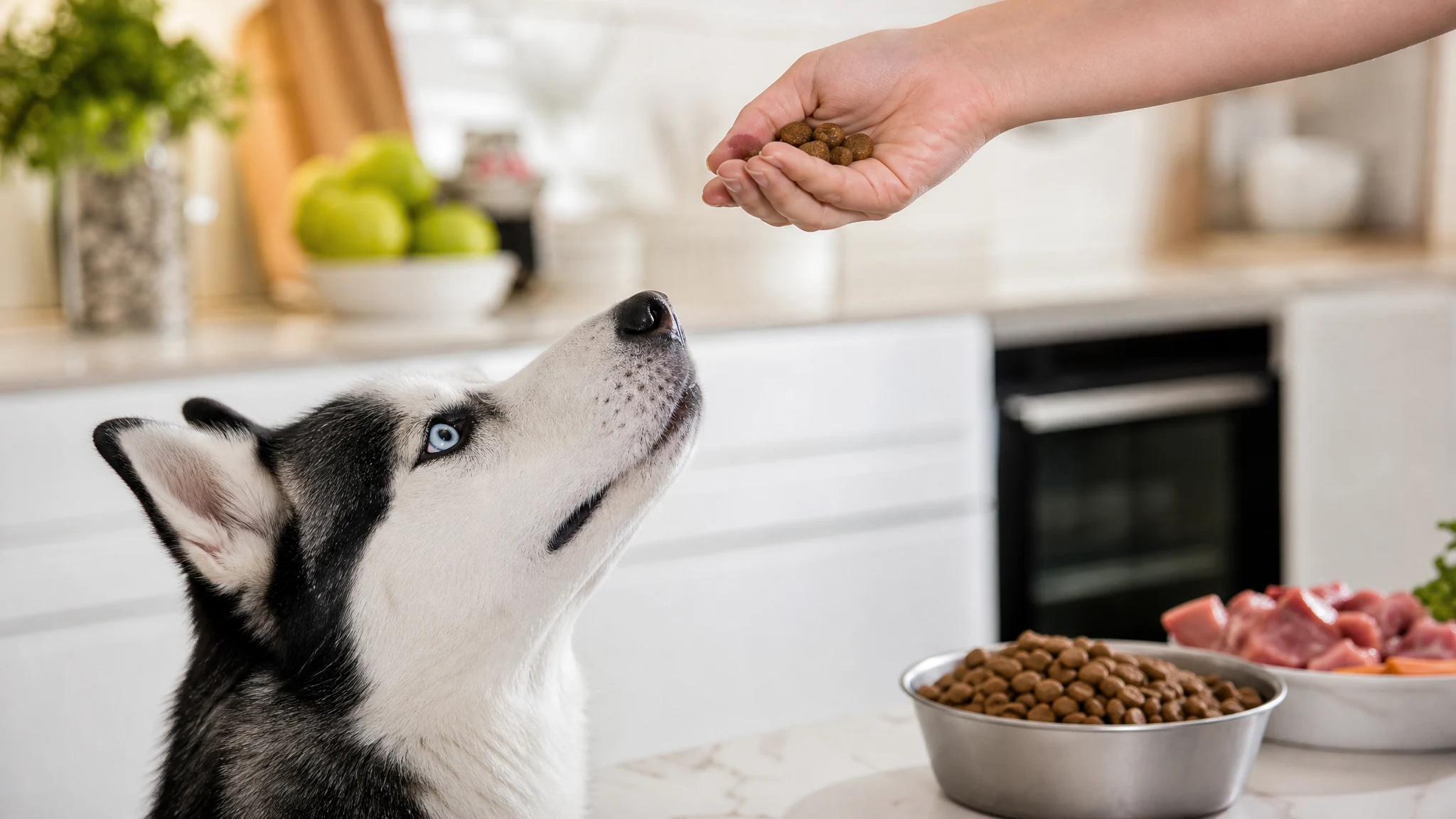
Huskies are smart, active and not always eager to please. That makes treats a useful tool, and also an easy way to overfeed. This guide shows how to choose the best treats for Huskies, how small to make them, and how to count them so they do not crowd out meals.
You will not find a ranked list of treat brands here. We did not feed or taste-test any treats. What follows is a method you can apply to any label you hold in your hand.
What You Need
- Your dog's regular food, with the calories per cup from the label.
- A kitchen scale or a measuring cup for the daily food portion.
- Two or three treat types, so you can tell which one your dog works hardest for.
- A small cutting board and a knife for shrinking treats.
- A treat pouch or a small container you can reach quickly.
- A notepad or phone note to track treats for the day.
If you are still choosing a main food, start with our label-by-label comparison of dog foods for Huskies. Treats work best when they sit on top of a solid daily diet.
Step 1: Know What Kind of Dog You Are Treating
The Westminster Kennel Club lists the Siberian Husky at usually 40 to 50 pounds, with a listed maximum of 60 pounds. That is a medium-sized dog with a lot of energy, so the daily calorie budget is not huge.
Ask your veterinarian what weight is right for your individual dog and how many calories a day fit that weight. Everything below builds on that number.
Step 2: Pick a Treat Category
Most husky treats fall into a few broad groups. Each has trade-offs.
Soft training treats
These are moist, chewy and easy to break into tiny pieces. They suit fast repetition, like practicing recall or loose-leash walking, because your dog swallows them quickly and keeps focus on you.
Read the ingredient list and the calories per treat. Some soft treats are very calorie-dense for their size.
Freeze-dried single protein
These are made from one animal protein, such as one type of meat. A short ingredient list makes them easier to track if your dog has had trouble with certain foods. Ask your veterinarian before assuming any treat is right for a dog with a known food problem.
They are light, strong-smelling and break apart easily. Many dogs find them high value, so they are good for harder tasks like training around distractions. Follow the brand's storage and handling directions on the package.
Vegetables
Small pieces of dog-safe vegetables can be a low-calorie option for dogs that like to crunch. Not every vegetable is safe for dogs, and some common kitchen foods, such as onions and grapes, are not. Check with your veterinarian before offering anything new.
Vegetables are usually lower value in your dog's eyes. Use them for easy cues your dog already knows.
Step 3: Read the Treat Label
Be skeptical of front-of-bag claims. Turn the package over and look for:
- Calories per treat or per piece. This is the number you need most. If it is missing, check the brand's own website or contact the brand.
- The ingredient list. Ingredients appear in order by weight. A short list is easier to compare.
- A nutritional adequacy statement. Many treats are labeled for intermittent or supplemental feeding only. That is a clue that the treat is not meant to be a meal.
- Guaranteed analysis. Protein, fat and fiber percentages help you compare two similar treats.
Words like "natural" or "premium" tell you little. The numbers and ingredients tell you more.
Step 4: Set the Daily Treat Budget
A widely used guideline, including in World Small Animal Veterinary Association (WSAVA) calorie guidance for pets, is to keep treats to about 10 percent of daily calories. The rest comes from complete and balanced food. Confirm the right share for your dog with your veterinarian, especially if your dog is overweight or has a health condition.
Here is the arithmetic, using a round example number that is not a Husky recommendation:
- Suppose your veterinarian says your dog needs 1,000 calories a day.
- Ten percent of that is 100 calories for treats.
- The other 900 calories come from meals.
Now swap in your own numbers. Then check your dog's food label for calories per cup. Food brands list this, and the figures vary a lot. For example, the Royal Canin USA product page gives 340 kcal per cup for Medium Adult dry and 360 kcal per cup for Large Adult dry. Hill's Pet Nutrition lists 365 kcal per cup for its Adult Large Breed dry food. Your dog's food will have its own number.
Feeding guides on food labels are starting points. Your dog's activity, age and body condition decide what is right, so adjust with your veterinarian's guidance.
Step 5: Make the Treats Small
Small pieces let you reward many times in a session without blowing the budget. A good rule of thumb is about the size of a pea, or a little bigger for a treat your dog needs to notice. Your dog does not need a full-size biscuit for sitting.
No official source sets a treat size for Huskies, so use your own judgment and watch your dog. If the dog takes a long time chewing, the piece is too big and the training rhythm suffers.
- Cut or break each treat into several pieces before the session.
- Count the pieces and note the calories for the whole batch.
- Put the batch in your pouch.
If you counted a batch as part of the day's budget, you will not have to guess later.
Step 6: Use Treats in a Training Session
Reward-based training is the approach supported by the American Veterinary Society of Animal Behavior (AVSAB). Treats are one way to pay your dog for choices you like.
- Keep sessions short. Five minutes, once or twice a day, is plenty. Stop while your dog is still interested.
- Mark and reward quickly. Say a short word like "yes" the moment your dog does the right thing, then deliver a treat within a second or two.
- Start with easy cues. Sit, hand targeting and name response build confidence.
- Raise the challenge slowly. Add distance, duration or distractions one at a time.
- Use higher-value treats for harder tasks. Save the strong-smelling ones for recall outdoors, and use lower-value ones at home.
- Fade the treats gradually. Once a behavior is reliable, reward it every second or third time, and mix in praise, play or a walk.
Many Huskies are independent and easily distracted by smells and movement. Practice in quiet places first. If your dog ignores a treat, try a different category before assuming the dog is stubborn.
Step 7: Track and Adjust
Keep a simple tally for a week. Write down treat calories and food calories. Then look at the dog.
- If you are well within the treat budget, you have room for more practice.
- If you are over, shrink the pieces, use more vegetables, or take a small amount out of the next meal.
- If your dog's body condition changes, talk to your veterinarian about the whole plan.
Tips for Better Sessions
- Rotate treats. Variety keeps interest up, but introduce new ones one at a time so you can spot a tummy upset.
- Use part of the meal. Some of your dog's kibble can serve as training rewards, which keeps total calories steady.
- Train before meals. A slightly hungry dog often works with more focus.
- Store treats well. Keep them sealed and out of reach. A clever Husky can open more containers than you expect.
- Tell everyone in the home. If three people each give "just one," the budget disappears.
Common Mistakes to Avoid
- Full-size treats for every rep. This is the fastest way to overshoot calories.
- Forgetting to count treats. Small bites add up over a day.
- Judging by the front of the bag. Check calories and ingredients on the back.
- Treating a treat as a meal. Many treats are not complete and balanced.
- Offering new foods without checking. Ask your veterinarian first, particularly with table scraps and vegetables.
- Using treats to fix fear or stress with force. Never pair treats with shock, prong or choke collars, scruffing or dominance methods. They are not part of humane training.
- Skipping the vet conversation. Dogs with allergies, weight problems or medical conditions may need a specific plan. A veterinarian decides what is right for an individual dog. No treat prevents, treats or cures a health condition.
What Results to Expect
With short, regular sessions and well-timed rewards, many dogs learn simple cues within a few weeks. Results vary with age, history and distractions, and Huskies can be slow to settle into focus outdoors. Counting treats can also help keep your dog's weight steadier, though body condition depends on the whole diet and activity.
Nothing here is a promise. Progress is rarely a straight line, so judge it over weeks, not days.
Quick Checklist
- Ask your veterinarian for your dog's daily calorie target.
- Take about 10 percent of that for treats.
- Choose one or two treat categories and read the labels.
- Cut treats to pea-sized pieces.
- Train in short sessions with quick rewards.
- Track the totals and adjust meals if needed.