A Printable Dog Feeding Chart, Adjusted for Huskies
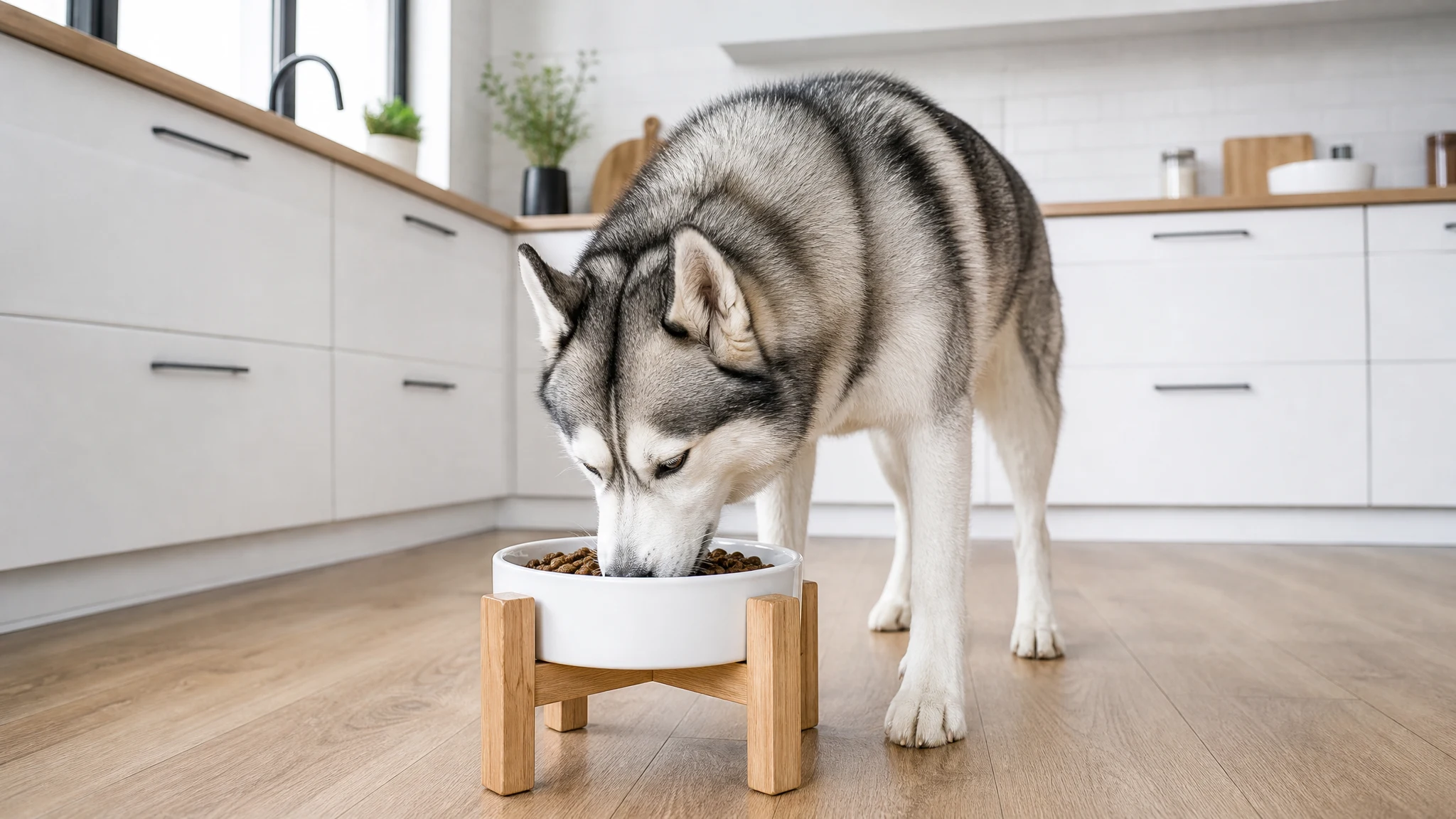
General nutrition information compiled from product labels and published sources, not veterinary advice. Your veterinarian is the right person to choose a diet for your dog, especially one with a health condition.
A feeding chart is only useful if it matches your dog. A generic chart assumes a generic dog. A Husky is a medium dog with a lot of stamina, and the number on the bag is a starting point, not a verdict.
This guide shows you how to build your own dog feeding chart on one sheet of paper. You will fill it in with your Husky's weight, your food's label data, and a routine you can check each week. For the full breakdown by life stage, see our Husky feeding chart by age and weight.
What You Need
- Your dog's current weight. A home scale works: weigh yourself, then weigh yourself holding the dog, and subtract.
- The food bag, can or package, so you can read the label.
- A measuring cup or, better, a kitchen scale. Royal Canin's Medium Adult page says grams are the most accurate form of measurement and that cups are given to the closest proximity.
- A pen and a printer, or a notebook you can rule into columns.
- Your veterinarian's phone number, for the questions below that a label cannot answer.
How We Approached This
We compared label data from the manufacturers' own pages. We did not run feeding trials or taste tests, and we did not feed any of these foods to dogs. Treat every number here as a label guide you will check against your own dog.
Step 1: Record Your Husky's Weight and Frame
The Westminster Kennel Club breed page lists the Siberian Husky's weight as usually 40 to 50 pounds, with a listed maximum of 60 pounds. That puts most Huskies in the medium range. Your dog may be outside it, so use your own scale reading, not the breed average.
Write the date and weight at the top of your chart. Add a second line for "goal weight." If you are unsure what that should be, ask your veterinarian to score your dog's body condition at the next visit.
Step 2: Copy the Key Label Facts
Turn to the label and copy four things onto the chart:
- The AAFCO statement. It tells you which life stage the food is built for, such as maintenance, growth or all life stages.
- Calories per cup or per can. This is the number that lets you compare foods fairly, because cups of different foods hold different energy.
- The feeding guide's weight bracket. Find the row that matches your dog's weight or expected adult weight.
- The first few ingredients. They are a snapshot, not a quality score.
If a brand does not state something, such as kibble size, write "ask the brand" rather than guessing.
Step 3: Match the Food to a Life Stage
The AAFCO statement matters more than the front-of-bag photo. Here is how a few foods describe themselves on the brands' own pages:
- Royal Canin lists its Medium Adult Dry for dogs 23 to 55 pounds as adults, at 340 kcal ME per cup, as fed, calculated.
- Royal Canin's Large Adult Dry is aimed at dogs 56 to 100 pounds as adults, at 360 kcal ME per cup.
- Hill's Science Diet Adult Large Breed Chicken & Barley is listed for an ideal weight of 55 to 110 pounds, at 365 kcal per cup.
- VICTOR's Classic Hi-Pro Plus is an all-life-stages food with an exception for large-size growth, at 406 kcal per cup.
Notice the spread. A cup of the VICTOR food carries about 20 percent more calories than a cup of Royal Canin Medium Adult, going by these pages. Swapping foods cup for cup would change what your dog eats without you noticing.
A Husky under 60 pounds usually falls in a medium bracket, but a dog near the top of the range may sit between brackets. Your veterinarian can help you choose.
Step 4: Set a Starting Amount
Find your dog's weight on the feeding guide and write down the amount. Treat it as a starting point. Hill's says to adjust feeding amounts as necessary to maintain optimal weight, and to ask your veterinarian if you are unsure.
Brands differ in how they present amounts. For example:
- Freshpet's Vital Large Breed page lists 2 1/2 to 3 cups per day for dogs of 51 to 65 pounds, as one meal or divided into two. It lists 337 kcal per cup.
- JustFoodForDogs' FreshFrozen Beef & Russet Potato page lists 1.5 to 2.5 cups for its medium bracket of 21 to 40 pounds. That bracket stops below the usual Husky range, so check the brand's larger rows for your dog.
- Royal Canin's Large Adult page has a table by target adult weight and activity level: low, moderate or high.
Those figures are not interchangeable. Each belongs to one product and one calorie density. Use only the table for the food in your bowl.
Step 5: Build the Printable Chart
Rule a page with the columns below. Print a few copies, or one per month.
| Column | What to write |
|---|---|
| Date and weight | Weigh every two to four weeks |
| Food and calories per cup | Copy from the label |
| Label starting amount | From the weight bracket |
| Amount you actually fed | In grams if you can |
| Treats and extras | Count them, because they add calories |
| Activity | Low, moderate or high that week |
| Body check | Ribs, waist, notes |
The activity column matters for this breed. A Husky who runs or pulls most days is not the same as one who naps through winter. Royal Canin's own guide splits amounts by activity level for that reason.
Step 6: Pick a Schedule
Many owners split the daily amount into two meals. Freshpet's page allows one meal or two. Beyond that, the sources we relied on do not give an age-by-age meal schedule for Huskies. Ask your veterinarian what is right for your dog's age, and write the answer on the chart.
Puppies need a food built for growth. Royal Canin's Large Puppy and Hill's large breed puppy foods are labeled for dogs expected to be 55 pounds or more as adults. Your Husky may be smaller, so a puppy food choice is a question for your veterinarian. The sources we used do not say when a Husky counts as an adult, so check with your vet and the food's brand.
Step 7: Adjust Every Few Weeks
Compare each new weight to the one before. If the weight is steady and the body check looks right to you and your vet, keep going. If the weight drifts, change the daily amount a little and weigh again later. Make one change at a time so you know what caused it.
Introduce a new food gradually. Hill's puppy page, for example, suggests transitioning over seven days.
Common Mistakes to Avoid
- Using the chart for the wrong life stage. A VICTOR food with the large-size growth exception, for instance, is not meant for large-breed puppies.
- Forgetting treats. Snacks and chews count toward the day's calories.
- Measuring by scoop. A heaped cup can hold much more than a level one. Weigh it if you can.
- Copying another dog's amount. Weight, age, activity and the food itself all change the answer.
- Treating a label as medical advice. No food on a chart prevents or treats a disease. A veterinarian decides what suits an individual dog.
A Note on Health Conditions
The Siberian Husky Club of America regards canine hip dysplasia as inheritable and of utmost concern in the breed. The club's page does not say how diet relates to it. If your Husky has a joint problem, a heart condition, allergies or any other diagnosis, confirm every amount on your chart with your veterinarian. Prescription diets are something only a veterinarian prescribes.
For questions about grain-free diets and heart disease, the FDA's investigation page on diets and canine dilated cardiomyopathy is the place to read. The FDA says its report counts do not establish a causal relationship, and its latest update on that page is dated December 23, 2022. Check the FDA page for anything newer, and ask your vet.
What to Expect
A chart like this may help you notice slow weight changes sooner and make feeding more consistent from week to week. It can also make vet visits easier, since you will have dates, weights and amounts on one page. It cannot promise a particular weight or health outcome. Dogs vary, and so does the way each food is made.
Sources
- Westminster Kennel Club, Siberian Husky breed page
- Siberian Husky Club of America, Hip Health
- FDA CVM, Investigation into Potential Link Between Certain Diets and Canine DCM
- Royal Canin, Medium Adult Dry
- Royal Canin, Large Adult Dry
- Hill's Science Diet, Adult Large Breed
- VICTOR, Classic Hi-Pro Plus
- Freshpet, Vital Large Breed
- JustFoodForDogs, FreshFrozen Beef & Russet Potato