What Is the Best Dog Food? How to Judge It for a Husky
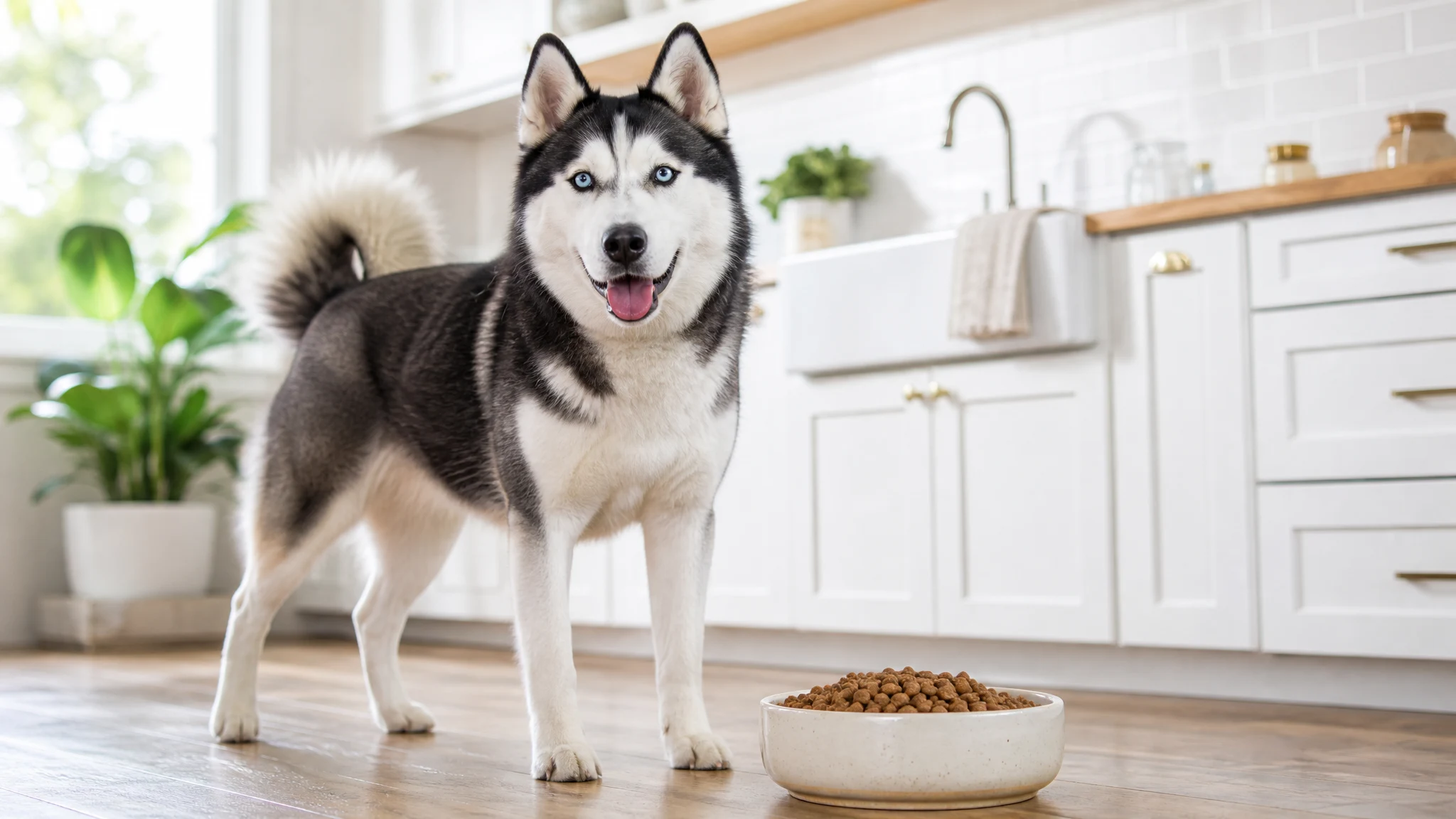
General nutrition information compiled from product labels and published sources, not veterinary advice. Your veterinarian is the right person to choose a diet for your dog, especially one with a health condition.
If you have asked yourself "what is the best dog food" for your Husky, the honest answer is that no single bag wins for every dog. What you can do is learn to read a label and compare foods on the same facts. This guide shows you how.
We compared label data from brand pages. We did not run feeding trials or taste tests, and we are not ranking foods by how a dog reacts to them. The goal is to help you judge a food, not to sell you one.
What You Need Before You Start
- Your Husky's current weight, from a scale at home or your vet's office.
- Your dog's age and life stage (puppy, adult or senior).
- The bag, can or brand page for each food you want to compare.
- A notepad or spreadsheet with one row per food.
- A list of questions for your veterinarian, including any health history.
Step 1: Know What Kind of Dog You Are Feeding
The Westminster Kennel Club lists the Siberian Husky as usually 40 to 50 pounds, with a listed maximum of 60 pounds. That puts most Huskies in the medium range of many brand size categories. Individual dogs vary, so use your own dog's weight.
Write down your dog's weight and life stage first. Every later step depends on them. For puppy ages and growth timing, check with your veterinarian or the Siberian Husky Club of America, because we did not find a confirmed age at which a Husky counts as an adult.
Step 2: Find the AAFCO Statement
The AAFCO statement is the most useful sentence on a label. It says which life stage the food is formulated for. It also tells you how the claim was supported, either by a formulation to the AAFCO Dog Food Nutrient Profiles or by feeding tests.
Look for one of these:
- Maintenance: meant for adult dogs.
- Growth: meant for puppies.
- All life stages: meant to cover puppies and adults.
Some labels add a large-size clause, such as "including growth of large size dogs (70 lb. or more as an adult)." According to Whole Dog Journal's guide to nutritional adequacy statements, this wording applies to foods that cover large puppies. A Husky is usually under 70 pounds as an adult, so the clause is not required for the breed. A food that says "except for growth of large size dogs" is a label detail to note, and your vet can say whether it matters for a Husky puppy.
Step 3: Match the Life Stage and Size Range
Brands set weight ranges on their own pages. Royal Canin's Medium Adult is described for dogs with an adult weight of 23 to 55 pounds. Its Large Adult is for 56 to 100 pounds. Many Huskies fall in the first range, and only the heaviest reach the second.
Hill's Science Diet Adult Large Breed lists an ideal weight of 55 to 110 pounds. That is above the usual Husky range, so check with your vet before choosing a large-breed adult formula for a typical Husky.
Step 4: Compare Protein, Fat and Calories
Dry foods list guaranteed analysis minimums for protein and fat. Calories are listed per cup or per kilogram. Put these in your notepad side by side.
| Food (brand page) | AAFCO statement | Protein min | Fat min | Calories | First ingredient |
|---|---|---|---|---|---|
| Royal Canin Medium Adult Dry | Meets AAFCO profiles (page says maintenance) | 23% | 12% | 340 kcal ME per cup | Brewers rice |
| VICTOR Classic Hi-Pro Plus | All life stages except growth of large size dogs | 30% | 20% | 406 kcal per cup | Beef meal |
| Freshpet Vital Large Breed (fresh) | All life stages | 20% | 14% | 337 kcal per cup | Chicken |
| Nom Nom Beef Mash (fresh, frozen) | All life stages, including large-size growth | 8% | 5% | 201 kcal per cup | Ground beef |
Do not compare the fresh foods to the dry foods by percentage alone. Fresh foods hold much more water, so their protein and fat numbers look low on an as-fed basis. Compare calories per cup, and ask the brand for dry matter figures if you want a fair comparison.
A higher number is not automatically better. VICTOR's page describes Classic Hi-Pro Plus as a high-protein formula for active dogs, and it has the most calories per cup of the four. That means a smaller scoop, and a mistake in portion size shows up faster. Whether a Husky needs that is a question for your vet.
Hill's lists dry matter averages instead of guaranteed analysis minimums on its pages. For example, Adult Large Breed Chicken & Barley shows 23.8% protein and 15% fat on a dry matter basis, at 365 kcal per cup. Those are not the same kind of number as the minimums above, so keep them in a separate column.
Step 5: Read the First Five Ingredients
Ingredients are listed by weight before cooking. The first five give a rough picture of the recipe. For example, Royal Canin Medium Adult starts with brewers rice, chicken by-product meal, oat groats, wheat and corn protein meal. Hill's Science Diet Adult Large Breed starts with chicken, cracked pearled barley, brown rice, brewers rice and whole grain wheat.
Be skeptical of marketing words. "Meal" and "by-product meal" are ingredient terms, not warnings. A fresh meat first ingredient contains water, so it can weigh more on the list than it contributes in the bowl. Use the list to see what the food is made of, not to declare it good or bad.
Step 6: Check Feeding Guides as a Starting Point
Every brand gives a feeding guide. Treat it as a place to start. Royal Canin says its guide is only a guide, and Hill's says to adjust amounts to maintain optimal weight and to ask your veterinarian if you are unsure.
Look at your dog's body condition every couple of weeks and adjust with your vet's help. Also count treats in the daily total.
Step 7: Think About Health Questions With Your Vet
Food labels do not treat or prevent disease, and we are not claiming any food does. A veterinarian decides what is right for an individual dog, and prescription diets are only something a veterinarian prescribes.
Two topics come up often:
- Hip health. The Siberian Husky Club of America says canine hip dysplasia is inheritable and of utmost concern in the breed. Its page does not link the condition to a particular diet, so ask your vet about weight and growth.
- Heart disease and diet. The FDA has investigated a possible link between certain diets and canine dilated cardiomyopathy. Its last update on the page we read was December 23, 2022, and it says report counts do not establish a causal relationship. Check the FDA page for anything newer and ask your vet.
Step 8: Pick Finalists and Transition Slowly
Narrow your notes to two or three foods that match your dog's life stage and weight. Then take them to your vet. Hill's suggests a 7-day transition for its large breed puppy food, which is a reasonable pattern for any change: mix a little new food into the old and shift gradually.
For more side-by-side label data, see our label-by-label comparison of dog foods for Huskies.
Tips and Common Mistakes
- Do not judge by the front of the bag. Words like "natural" and "premium" are not nutrient claims. Read the AAFCO statement and the analysis.
- Do not compare wet and dry by percentage. Water content changes the numbers.
- Do not pick on protein alone. Check fat and calories too, and match them to your dog's activity and body condition.
- Do not use an "except large-size growth" food for a puppy without asking. Check with your vet first.
- Do not skip the size range. A food made for 56 to 100 pound dogs may not suit a 45 pound Husky.
- Do not change foods overnight. Sudden switches can upset a dog's stomach.
- Do not trust missing data. Several brand pages do not state kibble size, so ask the brand if it matters for your dog.
What to Expect
A food that fits your dog's life stage and calorie needs may help support steady body weight, a healthy-looking coat and normal stools. Results vary from dog to dog, and no label can promise them. If you see vomiting, loose stools, itching, weight change or low energy, call your veterinarian rather than switching foods on your own.
So, what is the best dog food for a Husky? It is the one with an AAFCO statement for your dog's life stage, a size range that fits, calories you can portion carefully, and your vet's agreement.
Sources
- Westminster Kennel Club, Siberian Husky breed page
- Siberian Husky Club of America, Hip Health
- FDA CVM, Investigation into Potential Link Between Certain Diets and Canine DCM
- Whole Dog Journal, In the Fine Print: Nutritional Adequacy Statements
- Royal Canin, Medium Adult Dry
- Hill's Science Diet, Adult Large Breed Chicken & Barley
- VICTOR, Classic Hi-Pro Plus
- Freshpet, Vital Large Breed
- Nom Nom, Beef Mash