Wet vs Dry vs Fresh Food for Huskies
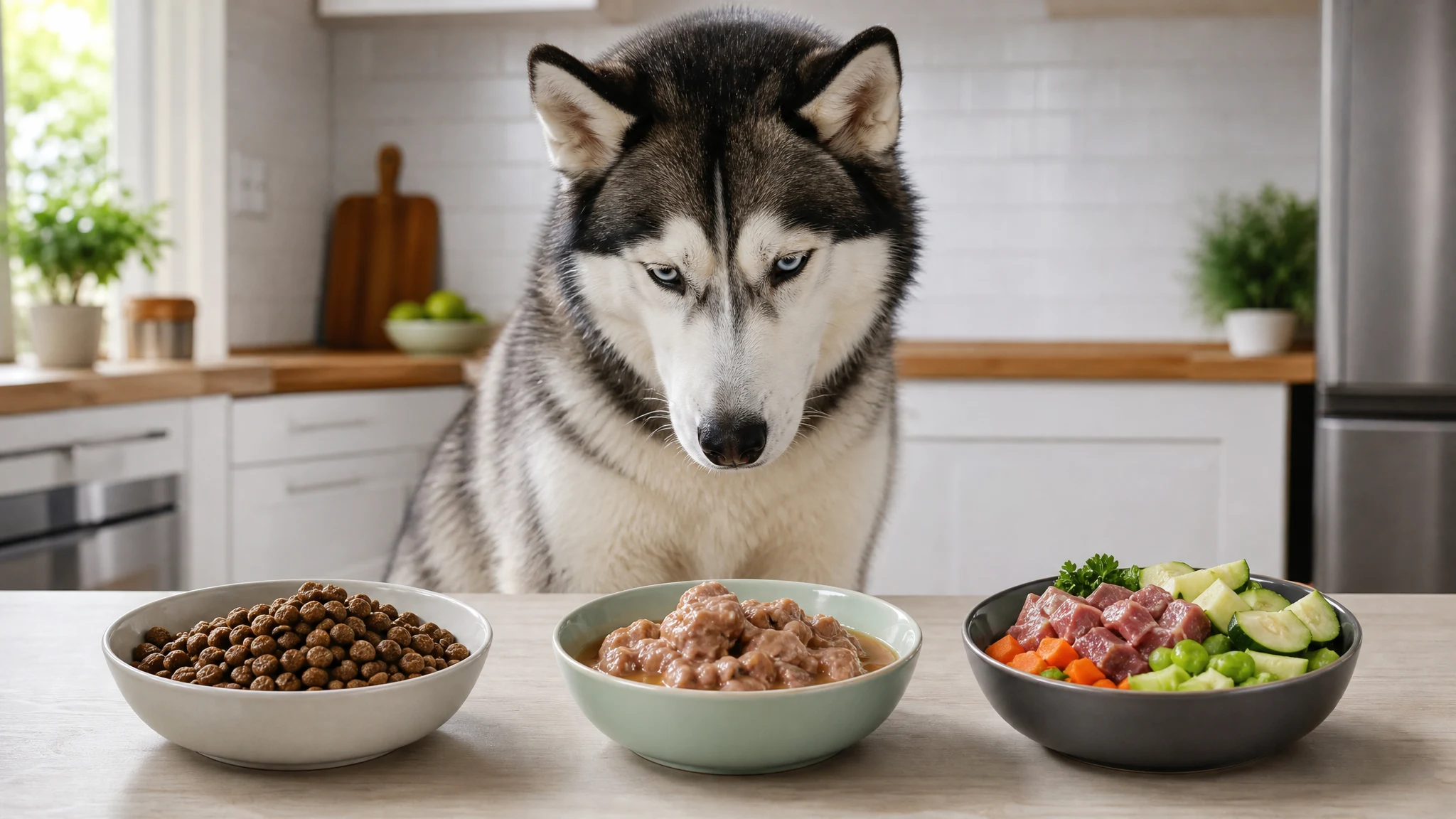
General nutrition information compiled from product labels and published sources, not veterinary advice. Your veterinarian is the right person to choose a diet for your dog, especially one with a health condition.
Most Husky owners end up asking the same question: is dry kibble enough, or is a wetter food worth the trouble? The short answer is that all three forms can be complete and balanced. What changes is calorie density, convenience, cost and how easy it is to measure a portion.
This page compares wet vs dry dog food, plus the fresh options, using label data only. We compared labels. We did not run feeding trials or taste tests, and we are not ranking foods by how dogs react to them.
The Husky starting point
The Westminster Kennel Club describes the Siberian Husky as usually 40 to 50 pounds, with a listed maximum of 60 pounds. That puts an adult Husky in the medium range, well under the 70 pound line that AAFCO uses for its large-size growth wording. The Westminster page lists a maximum life expectancy of 14 years.
None of the sources we relied on gives a Husky-specific form of food, and we found no brand that sells a Husky-specific formula. So the question is really about which form fits your dog, your budget and your routine. For the full product-by-product view, see our label-by-label comparison of dog foods for Huskies.
Comparison table
| Attribute | Dry | Wet (canned) | Fresh (refrigerated or frozen) |
|---|---|---|---|
| Label examples used | Royal Canin Medium Adult, VICTOR Classic Hi-Pro Plus | Hill's Science Diet Adult Chicken & Barley Entree | Freshpet Vital Large Breed, Nom Nom Beef Mash, JustFoodForDogs Beef & Russet Potato |
| Moisture | Low | High; water is the first ingredient on the Hill's wet label | High |
| Calories on the label | 340 kcal per cup (Royal Canin Medium Adult); 406 kcal per cup (VICTOR Classic Hi-Pro Plus) | 369 kcal per 13 oz can (Hill's) | 337 kcal per cup (Freshpet); 201 kcal per cup (Nom Nom); 1,559 kcal/kg, or 44 kcal/oz (JustFoodForDogs) |
| Cost per day, in general terms | Usually the lowest of the three, though it varies by brand | Can add up if it is the whole diet | Usually the highest, since lower calories per cup means more volume |
| Storage | Pantry | Pantry until opened, then refrigerate | Refrigerator or freezer |
| Portioning | Easy to scoop | Easy by the can | Depends on the format |
The cost row is general, not a price. We are not quoting any prices because they change and vary by store. Check each brand's own page and do the math per day for your dog.
Dry food
Dry food is the default for good reasons. It stores easily, it is simple to measure and it is calorie-dense. The Royal Canin USA page lists Medium Adult at 340 kcal ME per cup, for adult dogs of 23 to 55 pounds, which covers a typical Husky. The Royal Canin Medium Adult page says its feeding guide is only a guide, and that grams are more accurate than cups.
The VICTOR Classic Hi-Pro Plus is a different kind of dry food. Its page lists 30% minimum protein, 20% minimum fat and 406 kcal per cup, and it is marketed for active dogs. Its AAFCO statement is for all life stages except growth of large-size dogs, so it is not meant for large-breed puppies. A Husky is not a large breed by the AAFCO definition, but check with the brand and your veterinarian about puppies. The VICTOR product page has the details.
Pros
- Easy to store, scoop and travel with.
- Calorie-dense, so portions are small.
- Often the lowest cost per day.
- Many labels list a full guaranteed analysis, which makes comparing easier.
Cons
- Low moisture, so water intake matters.
- Calorie density makes it easy to overfeed by a few extra scoops.
- Some dogs find it less appealing.
Wet food for Huskies
Wet food for Huskies is mostly a choice about appeal and moisture. The Hill's Science Diet Adult Chicken & Barley Entree lists water first, then chicken, pork liver, whole grain corn and cracked pearled barley. The label cites 369 kcal per 13 oz can, so the calorie count is per can, not per cup. That makes it hard to compare directly with a dry food measured in cups.
The Hill's wet label gives dry matter averages instead of a guaranteed analysis minimum: 26.5% protein, 17% fat and 1.4% crude fiber. We could not confirm the original Hill's page for this wet food, so we are not linking one. Check with Hill's for the current label and feeding table. The brand says its recommendations are only a guide and a place to start.
Pros
- High moisture and strong aroma, which can help a picky eater.
- Easy to portion by the can.
- Works as a topper or partial meal.
Cons
- Once opened, leftovers need refrigerating.
- Calories are spread across more volume, so a full wet diet means more cans a day.
- Costs more per day than kibble when it is the whole diet.
Fresh dog food for Huskies
Fresh dog food for Huskies is the most varied category, so it is worth reading each label on its own terms.
- Freshpet Vital Large Breed lists chicken, beef, egg, salmon and beef liver first, with 20% minimum protein, 14% minimum fat and 337 kcal per cup. Its AAFCO statement is for all life stages. Freshpet's page gives a feeding amount for 51 to 65 pound dogs, which is above the usual Husky range, so find the line for your own dog's weight. See the Freshpet product page.
- Nom Nom Beef Mash lists ground beef, russet potatoes, eggs, carrots and peas first, at 201 kcal per cup. Its AAFCO statement covers all life stages, including large-size growth. See the Nom Nom page.
- JustFoodForDogs FreshFrozen Beef & Russet Potato is listed at 1,559 kcal/kg (44 kcal/oz), and its statement is for adult maintenance. The page lists growing puppies as a poor fit. See the JustFoodForDogs page.
Note the protein figures. Nom Nom lists 8% minimum protein and JustFoodForDogs 8.5%, against 23% to 30% on the dry labels. That does not mean the fresh foods are lower in protein. Water inflates the weight of a wet food, so as-fed percentages from foods with different moisture cannot be compared directly. A veterinarian can help you convert to a dry matter basis.
Pros
- Ingredient lists read like whole foods, which many owners prefer.
- High moisture and strong appeal.
- Some labels, such as Freshpet and Nom Nom, cover all life stages.
Cons
- Requires refrigerator or freezer space.
- Usually the highest cost per day.
- Calories per cup vary widely (201 to 337 on the labels above), so you cannot swap one for another cup for cup.
- The AAFCO statements differ. Check whether a recipe is for adults only before feeding it to a puppy.
Calories per serving: why the numbers mislead
A cup of one food is not a cup of another. On these labels, a cup of Nom Nom Beef Mash is 201 kcal, while a cup of VICTOR Classic Hi-Pro Plus is 406 kcal. Feeding the same volume of each would give very different energy intakes.
Always start from the calories on the label and the feeding guide for your dog's weight. Treat the guide as a starting point, then adjust with your veterinarian based on body condition. Huskies vary in activity, so the label amount for a working sled dog and a couch dog should not be the same.
Dental myths
One common claim is that dry food cleans teeth and wet food ruins them. None of the labels we compared makes a dental claim, and we found nothing in the sources used here that supports that either way. Do not choose a form based on this myth, and do not skip dental care because your dog eats kibble. Your veterinarian can tell you what your dog's teeth need.
Kibble size and mouth shape
Kibble size comes up for dogs with small or flat-faced mouths. The Husky is not described that way in the sources we used, and none of the product pages we read states a kibble size. Royal Canin says only that its large-breed kibble is designed for large jaws, and VICTOR says its large-breed puppy kibble is sized for large breeds. If size matters for your dog, ask the brand for the actual dimensions.
Mixing forms
Mixing is common: a scoop of kibble with a spoonful of wet or fresh food on top. It is fine in principle if both foods are complete and balanced, but there are two cautions.
- Count the calories from both. Adding wet food on top of a full kibble portion is an easy way to overfeed. Cut back the kibble to make room.
- Change slowly. Hill's suggests a gradual transition of about 7 days on one of its pages, which is a reasonable pattern for any switch.
A topper can make meals more appealing without paying for a full fresh diet.
A note on grain-free and heart health
JustFoodForDogs lists its Beef & Russet Potato recipe as grain-free. The FDA's investigation into a possible link between certain diets and canine dilated cardiomyopathy (DCM) has a last update dated December 23, 2022. The FDA said report counts do not establish a causal relationship and that it would not issue further public updates until there is meaningful new scientific information. We did not check for anything newer, and no food here is presented as preventing or treating any condition. If you are weighing a grain-free or boutique diet, ask your veterinarian.
Best for: by use case
- Tight budget or simple routine: dry food in an adult medium-breed formula.
- Picky eater: a wet topper on a measured kibble portion.
- Owner who wants whole-food ingredients and has freezer space: fresh, with attention to AAFCO statements.
- Husky puppy: a food whose AAFCO statement covers growth. Check the statement, and do not use an adult-only recipe.
- Travel or storage limits: dry.
Verdict
For most adult Huskies, a complete and balanced dry food is the practical baseline. It is simple to measure, calorie-dense and usually the lowest cost per day. Wet food for Huskies works best as a topper or for dogs that need more appeal, and fresh food suits owners who value the ingredient style and can accept the cost and storage.
No form is clearly better for a Husky on the evidence we compared. Whichever you pick, check that the label has an AAFCO statement that matches your dog's life stage, start from the calories and feeding guide on the label, and let your veterinarian decide anything specific to your dog.