Best Puppy Food for Husky Puppies
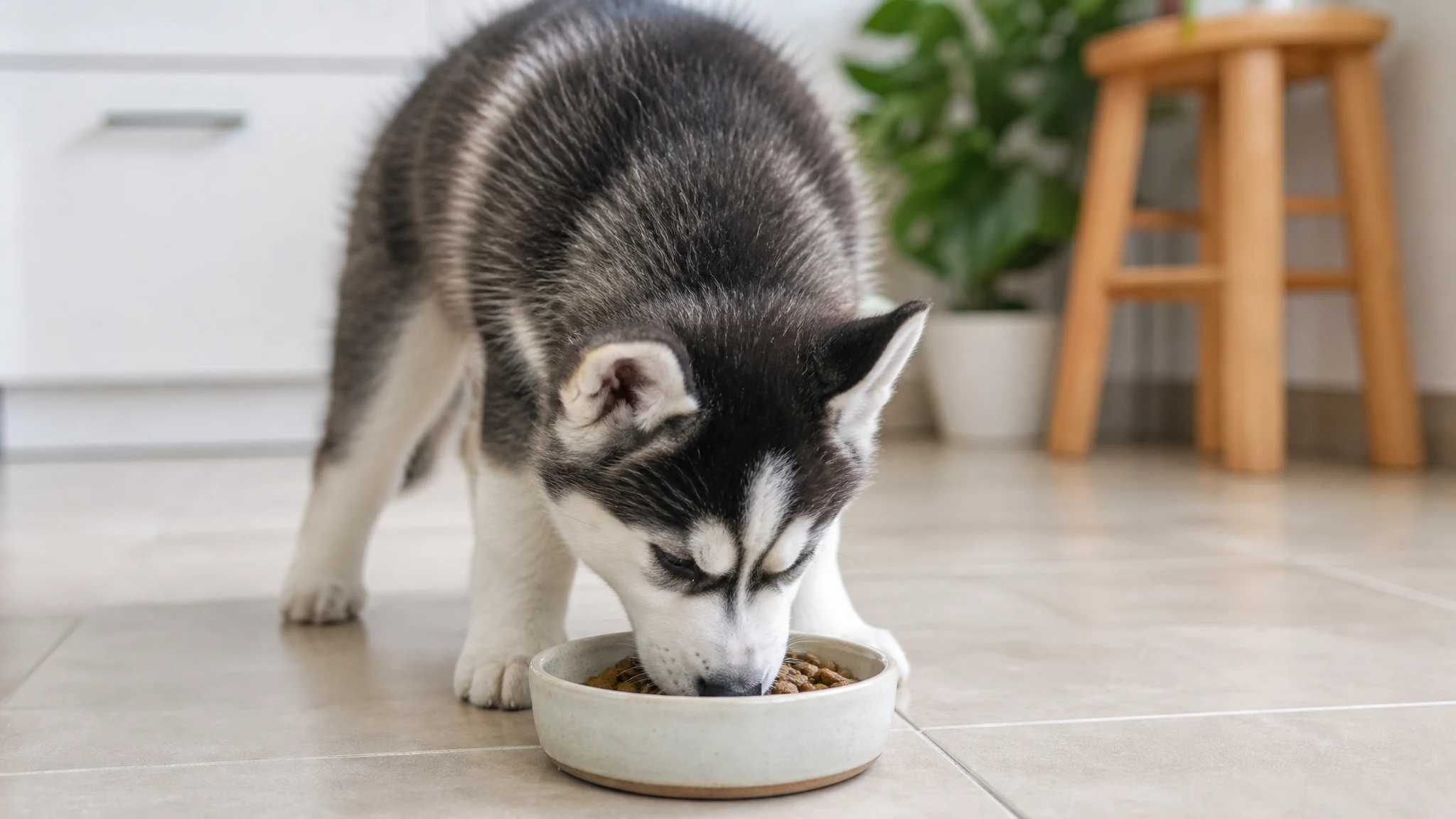
General nutrition information compiled from product labels and published sources, not veterinary advice. Your veterinarian is the right person to choose a diet for your dog, especially one with a health condition.
Choosing the best puppy food for huskies starts with the label, not the front of the bag. Marketing words like "premium" or "ancestral" tell you very little. The nutritional adequacy statement, the ingredient list and the calorie count tell you much more.
This guide explains how to read those parts and what to compare. It then walks through several foods whose labels say they cover growth. Whether you are looking for the best food for a Husky puppy or just a sensible starting point, the aim is the same: a food that is complete for growing dogs, fed in measured amounts, with your veterinarian guiding the details.
How we compared these foods
We compared label data published by each brand: the AAFCO statement, the first ingredients, the guaranteed analysis where it is given, and calories per cup. We did not run feeding trials or taste tests, and we are not rating how any dog does on any food. A label comparison can narrow the field. It cannot tell you how your puppy will do.
We also left out foods whose statement does not cover growth. A food for adult maintenance is not a puppy food, however good the ingredients look.
What to know about the Husky first
The Westminster Kennel Club breed page lists the Siberian Husky as usually 40 to 50 pounds, with a listed maximum of 60 pounds. That puts the adult Husky in the medium range, below the 70 pound line that AAFCO uses for "large-size" dogs.
This matters when you read labels. Many puppy foods are sold as "large breed," and some of those are written for dogs that will reach 56 pounds or more. A Husky may land at the lower edge of those ranges or below them. The sizing is a starting point for the conversation with your veterinarian, not a rule.
None of the foods compared here is made specifically for Huskies. If a bag calls itself a Husky formula, read the same label parts described below and check with the brand about what makes it breed specific.
We do not have a sourced figure for when a Husky puppy counts as an adult. Growth speed varies between dogs. Ask your veterinarian when to move to an adult food, and check each brand's own life stage range on its page.
What to look for: quality indicators
1. An AAFCO statement that covers growth
This is the first thing to check. A puppy food should say it meets the AAFCO Dog Food Nutrient Profiles for growth, or for all life stages. Some statements add a clause about large dogs. The wording, as described by Whole Dog Journal, is "including growth of large-size dogs (70 pounds or more as an adult)."
A Husky is expected to stay under 70 pounds, so that clause is not required for the breed. A food that carries it is still a reasonable choice. A food that says it covers all life stages except growth of large-size dogs carries a different exception. Ask your veterinarian before choosing one for a puppy.
Some statements also say the food was proven through feeding tests using AAFCO procedures. Others say it was formulated to meet the profiles. Both are accepted claims, and they are not the same thing. Neither one means a food is right for an individual dog.
2. A named protein source near the top
Ingredients are listed by weight before cooking. Look at the first five. Chicken, beef or a named meal is more informative than a vague term. Note that "chicken by-product meal" is a named ingredient, but it is not the same as whole chicken. Meals are concentrated because the water has been removed, so a meal high on the list can mean more protein than a fresh meat in the same position.
Do not judge a food on one ingredient. The whole panel matters, and so does the guaranteed analysis.
3. Calories per cup
Calories per cup vary a lot between foods. Two foods can both be a "cup" and differ by more than 40 calories in that cup. If you switch brands, the same scoop does not mean the same energy. Compare calories, not just cups.
4. A feeding guide you can follow
A good label gives a feeding table by weight or age. Treat it as a starting point, as the brands themselves do. Hill's, for example, tells owners to adjust amounts to maintain optimal weight and to ask a veterinarian if unsure.
Key features to compare
These are the label data points for the growth-appropriate foods we compared. All are non-grain-free, with grains or similar starches in their ingredient lists. Values come from each brand's own product page. "Not stated" means the page does not give that figure.
| Food | Form | Growth coverage on label | First ingredients | Calories |
|---|---|---|---|---|
| Royal Canin Large Puppy Dry | Dry | Growth, including large-size dogs (70 lb or more as an adult) | Chicken by-product meal, corn, wheat, chicken fat, wheat gluten | 349 kcal per cup |
| Hill's Science Diet Puppy Large Breed Chicken & Brown Rice | Dry | Complete and balanced for growing puppies (feeding tests) | Chicken, brown rice, whole grain oats, chicken meal, cracked pearled barley | 387 kcal per cup |
| VICTOR Hi-Pro Plus Large Breed Puppy | Dry | All life stages, including large-size dogs (70 lb or more as an adult) | Chicken, chicken meal, brown rice, whole grain millet, whole grain sorghum | 365 kcal per cup |
| Freshpet Vital Large Breed | Fresh, refrigerated | All life stages (full sentence not shown on the page) | Chicken, beef, egg, salmon, beef liver | 337 kcal per cup |
| Nom Nom Beef Mash | Fresh, frozen and cooked | All life stages, including large-size dogs (70 lb or more as an adult) | Ground beef, russet potatoes, eggs, carrots, peas | 201 kcal per cup |
Do not compare the protein percentages of dry and fresh foods side by side. Fresh foods contain much more water, so their as-fed numbers look lower even when the nutrition is complete. Compare within a form, or ask the brand for dry matter values.
Top picks by type of food
We have no price data from the brands, and prices change with bag size, store and region. We will not guess at what anything costs. Instead the picks below are grouped by the kind of food, since form is the main thing that tends to change the price. Check each brand's page for current pricing and sizes.
Dry foods
Royal Canin Large Puppy Dry says it meets the AAFCO profiles for growth, including growth of large-size dogs. It lists a 28% minimum protein, 14% minimum fat and 3.7% maximum fiber. The page says the food is for large-breed puppies up to 15 months, with an adult weight of 56 to 100 pounds. A Husky usually finishes smaller, so ask your veterinarian whether a large-breed formula suits your puppy. The brand's page links to a feeding calculator, and the feeding chart on the page itself is an image.
Hill's Science Diet Puppy Large Breed Chicken & Brown Rice lists chicken as the first ingredient and states that feeding tests using AAFCO procedures substantiate it for growing puppies. The page gives no guaranteed analysis minimums. It gives dry matter averages instead: 26.7% protein, 15.4% fat and 2.8% crude fiber. It is labeled for large-breed puppies up to 18 months, and for dogs over 55 pounds as adults. Hill's advises a 7 day transition and adjusting amounts to maintain optimal weight.
VICTOR Hi-Pro Plus Large Breed Puppy is the most energy-dense dry option here at 365 kcal per cup, with 30% minimum protein, 14% minimum fat and a 6% maximum fiber. Its statement covers all life stages including large-size growth. The label lists chicken and chicken meal first.
A note on a related VICTOR product: Classic Hi-Pro Plus carries an AAFCO exception for growth of large-size dogs (70 pounds or more as an adult). We do not suggest it for puppies without your veterinarian's approval.
Fresh foods
Freshpet Vital Large Breed is refrigerated. It lists chicken, beef, egg, salmon and beef liver as its first five ingredients, with 20% minimum protein, 14% minimum fat and 1% maximum fiber as fed. The page states the food is for all life stages, though the full AAFCO sentence is not shown in what we compared. Check the brand's page or ask the brand directly before relying on it for a growing puppy.
Nom Nom Beef Mash is frozen and cooked. Its statement covers all life stages including growth of large-size dogs. At 201 kcal per cup it is far less calorie dense than the dry foods, so cup amounts are not comparable across forms. Its as-fed minimums are 8% protein and 5% fat, with 4% maximum fiber.
Foods we left out
JustFoodForDogs FreshFrozen Beef & Russet Potato is labeled for adult maintenance, and the brand's page lists growing puppies as a group it is not for. Hill's Science Diet adult and mature adult recipes are likewise for adult dogs. These are not puppy foods, so we did not include them.
Feeding a Husky puppy
Brands give feeding guides by weight, and these are a starting point. Your puppy's body condition, activity and growth should adjust the amount. Your veterinarian can tell you whether your puppy looks lean and well muscled or is gaining too fast.
Young puppies usually do better with several small meals across the day than with one large one. Your veterinarian can set the number of meals for your puppy's age, and the schedule will change as the puppy grows. Measure each meal. Use a cup or a scale rather than guessing, since calories per cup differ so much between foods.
Switch foods slowly. Hill's recommends a 7 day transition for its puppy food. Mix a little of the new food into the old and shift the ratio over the week. Watch the stool.
When the time comes to move to an adult food, do it with your veterinarian's guidance. We have no sourced age for Huskies, and each brand lists its own life stage window, such as Royal Canin's 15 months or Hill's 18 months for their large-breed puppy foods.
Diet and health: what the sources say
The Siberian Husky Club of America regards canine hip dysplasia as inheritable and of the utmost concern in the breed. It reports that the Orthopedic Foundation for Animals evaluated 12,087 Huskies from 1994 to 1998 and found only 2.2% dysplastic. The club's page does not tie that to any food, and we do not suggest that any food prevents or treats it. Screening and breeding decisions are matters for breeders and your veterinarian.
Grain-free diets have come up in the FDA's investigation into a possible link between certain diets and canine dilated cardiomyopathy (DCM). The FDA's latest update is dated December 23, 2022. It states that report counts do not establish a causal relationship, and that it does not plan further public updates until there is meaningful new scientific information. We have not checked for anything newer. If you are weighing grain-free against grain-inclusive foods, your veterinarian is the right person to ask. All of the foods compared here include grains or starches in their listed ingredients.
Red flags to avoid
- No AAFCO statement, or one that only covers adult maintenance. A puppy needs a statement covering growth or all life stages.
- An exception for large-size growth that you did not notice. Read the end of the statement.
- Vague claims. Terms like "holistic" or "human grade" are not nutritional guarantees. Look for the numbers.
- Promises about health. A food label or website that claims to prevent or cure a condition is overreaching. Only a veterinarian prescribes a diet for a medical problem.
- No calorie information. Without calories per cup, you cannot fairly compare foods or measure meals.
- Feeding amounts with no guidance on adjusting. Good brands say their guide is a start.
- Unexplained jumps in feeding amount. If a switch changes your puppy's weight fast, talk to your veterinarian.
Where to buy
We do not link to stores or sell anything. A few practical points apply wherever you shop.
- Start at the brand's own page. Each product link above goes there. The page shows the current statement and ingredient list, and often a store locator or ordering information.
- Check the bag against the page. Formulas change, and sizes and recipes with similar names can differ. Read the statement on the bag you are holding.
- Check dates and packaging. Look for an intact bag and a best-by date, and store food as the brand directs. Fresh and frozen foods have their own storage needs.
- Ask your veterinarian's office. They can tell you which brands they see doing well and what is available locally.
A simple way to decide
- Confirm that the statement covers growth or all life stages.
- Compare calories per cup, not just the price of the bag.
- Pick a food in a form you can feed consistently.
- Measure meals and watch your puppy's body condition.
- Review the plan with your veterinarian at each checkup, especially around the time of switching to adult food.
No single food is the right answer for every Husky puppy. The best option is one with a clear growth statement and a label that tells you what you need to know, fed in measured amounts and adjusted with your veterinarian.
Sources
- Westminster Kennel Club, Siberian Husky breed page
- Siberian Husky Club of America, Hip Health
- FDA Center for Veterinary Medicine, Investigation into Potential Link Between Certain Diets and Canine DCM
- Whole Dog Journal, In the Fine Print: Nutritional Adequacy Statements
- Royal Canin USA, Large Puppy Dry
- Hill's Pet Nutrition, Science Diet Puppy Large Breed
- VICTOR Pet Food, Hi-Pro Plus Large Breed Puppy
- Freshpet, Vital Large Breed
- Nom Nom, Beef Mash