4Health Dog Food for Huskies: How It Compares on the Label
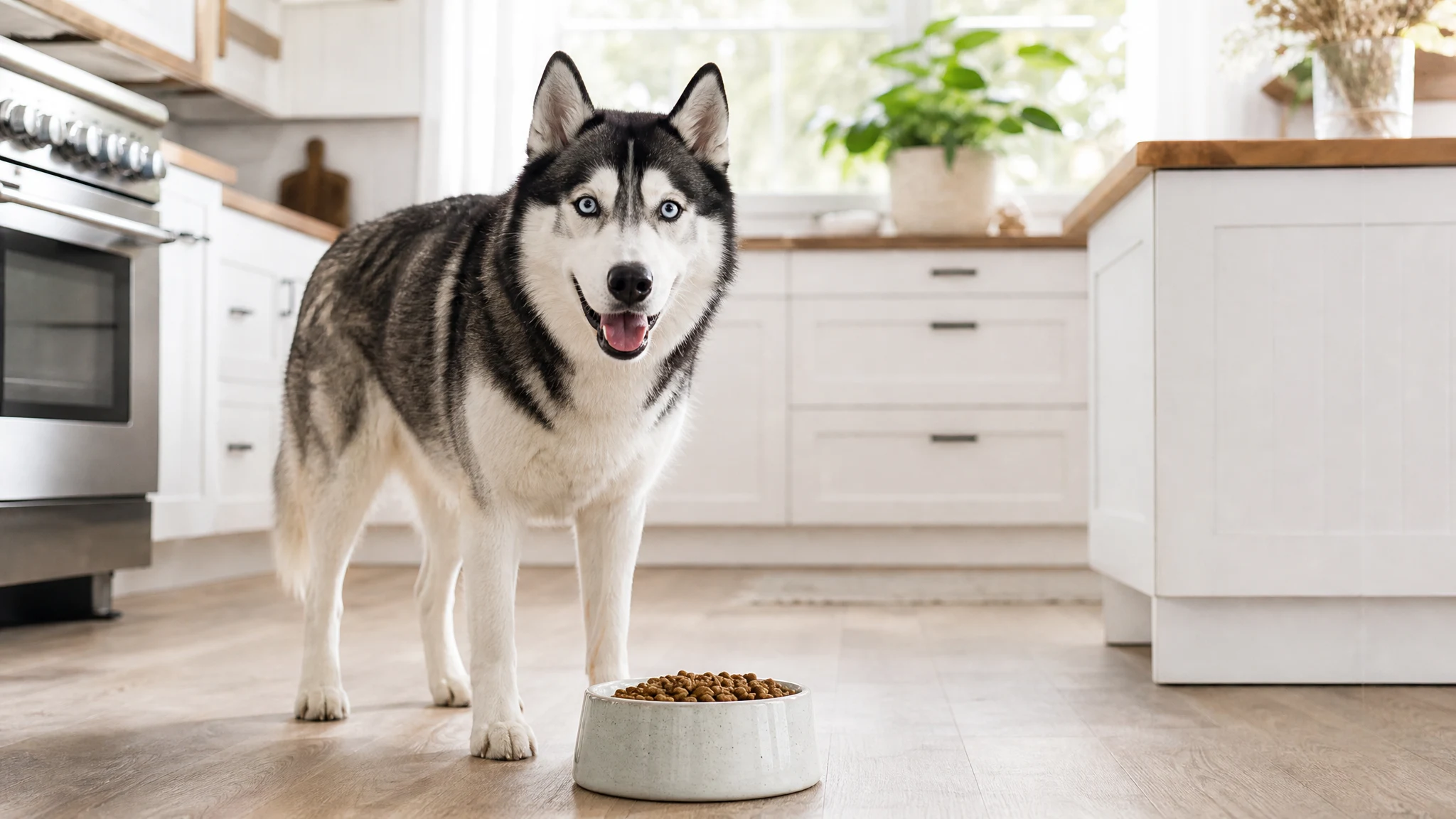
General nutrition information compiled from product labels and published sources, not veterinary advice. Your veterinarian is the right person to choose a diet for your dog, especially one with a health condition.
Choosing a bag for a Siberian Husky is easier when you stop reading the front and start reading the back. This guide shows you how to check 4 health dog food against the label data of other foods, step by step.
One honest note first. We compared label data only. We did not run feeding trials or taste tests, and we have not fed any of these foods to a dog. We also do not have 4Health's current label figures in hand, so you will pull those from the brand's own product page and fill in the comparison yourself.
What You Need Before You Start
- The bag, or the brand's own product page, for the 4Health formula you are considering.
- The same label details for one or two other foods you are weighing.
- Your dog's age, current weight and activity level.
- A pen and paper, or a simple spreadsheet with one column per food.
- A calculator for a calorie check.
- Your veterinarian's number, since they decide what suits an individual dog.
Know the Dog First
The Westminster Kennel Club breed page lists the Siberian Husky at usually 40 to 50 pounds, with a listed maximum of 60 pounds. It gives a maximum life expectancy of 14 years. Individual dogs vary, so use your own dog's weight, not the average.
That weight range matters when you read size-based labels. Royal Canin's Medium Adult is written for adult dogs of 23 to 55 pounds. Its Large Adult is for 56 to 100 pounds. A 45-pound Husky and a 58-pound Husky could land on different sides of that line, so ask your veterinarian which fits.
Step 1: Find the AAFCO Statement
The AAFCO statement is the most useful sentence on the bag. It says whether the food is formulated for maintenance, growth, or all life stages. It also says whether that was shown by a formulation to the AAFCO nutrient profiles or by feeding tests.
The wording differs by brand. Hill's Science Diet Adult Large Breed says animal feeding tests using AAFCO procedures substantiate complete and balanced nutrition for adult maintenance. Royal Canin Large Adult says it is formulated to meet the AAFCO Dog Food Nutrient Profiles for maintenance. Those are two different ways of backing a claim, and both are worth noting.
Write down the exact statement for 4Health. If you cannot find one, check with the brand before going further.
Step 2: Match the Life Stage
A puppy needs a growth or all-life-stages statement. An adult can use maintenance or all life stages. Do not assume a food suits both.
The Whole Dog Journal explains that AAFCO wording for large puppies reads "including growth of large-size dogs (70 pounds or more as an adult)." Since a Husky is under 70 pounds as an adult, that clause is not required for the breed. Some foods carry the opposite caveat. VICTOR Classic Hi-Pro Plus is labeled for all life stages except growth of large-size dogs, which is a note to read, not a flaw. Check your own formula for the same kind of exception.
Step 3: Read Protein and Fat
Find the guaranteed analysis. Protein and fat are listed as minimums, and fiber as a maximum. Compare like with like, meaning dry food against dry food.
Some brands do not show these the same way. The Hill's pages we used give dry matter averages instead of guaranteed minimums, so those numbers are not directly comparable to a minimum on another bag. Write down which kind of figure you have.
Step 4: Check Calories per Cup
Calories decide how much you scoop. Two foods with the same protein can differ a lot in energy per cup.
Brand pages give these figures: Royal Canin Large Adult at 360 kcal per cup, Royal Canin Medium Adult at 340, Hill's Adult Large Breed at 365, and VICTOR Classic Hi-Pro Plus at 406. Treat 4Health the same way. Take the kcal per cup from its page and note whether it is calculated or measured.
Step 5: Read the First Five Ingredients
Ingredients are listed by weight before cooking. The first five show the main building blocks of the recipe. Do not read them as a quality score.
For example, Royal Canin Medium Adult lists brewers rice, chicken by-product meal, oat groats, wheat and corn protein meal. VICTOR Classic Hi-Pro Plus lists beef meal, grain sorghum, chicken fat, whole grain millet and blood meal. Hill's Adult Large Breed starts with chicken, cracked pearled barley and brown rice. Each is a different design. Note what you see for 4Health and look for ingredients your dog has not tolerated before.
Step 6: Put It in One Table
Fill in a grid like the one below. The rows here come from the brands' own pages. The 4Health row is yours to complete.
| Food | AAFCO basis | Protein min | Fat min | kcal per cup | First ingredients |
|---|---|---|---|---|---|
| 4Health (your formula) | Copy from the brand page | Copy | Copy | Copy | Copy |
| Royal Canin Medium Adult | Nutrient profiles, maintenance | 23% | 12% | 340 | Brewers rice, chicken by-product meal, oat groats |
| Royal Canin Large Adult | Nutrient profiles, maintenance | 24% | 15% | 360 | Chicken by-product meal, brewers rice, wheat |
| Hill's Science Diet Adult Large Breed | Feeding tests, maintenance | Not stated (23.8% dry matter average) | Not stated (15% dry matter average) | 365 | Chicken, cracked pearled barley, brown rice |
| VICTOR Classic Hi-Pro Plus | Nutrient profiles, all life stages except large-size growth | 30% | 20% | 406 | Beef meal, grain sorghum, chicken fat |
For a wider look at other foods, see our label-by-label comparison of dog foods for Huskies.
Step 7: Treat the Feeding Guide as a Starting Point
Every feeding chart is a guide, not a prescription. Hill's says to adjust amounts to maintain optimal weight and to ask your veterinarian if unsure. Royal Canin says its Medium Adult chart is only a guide.
Start at the label amount for your dog's target weight. Then watch body condition over a few weeks and adjust. Your veterinarian can confirm a healthy weight.
Step 8: Take Your Notes to Your Veterinarian
Bring the grid. A veterinarian can weigh it against your dog's age, weight, health history and activity.
This is also the place to ask about specific conditions. The Siberian Husky Club of America regards canine hip dysplasia as inheritable and of utmost concern in the breed. Its page does not link the condition to any food, so do not assume a bag can address it. On heart health, the FDA's investigation into diets and canine dilated cardiomyopathy had its latest update on December 23, 2022. The FDA said report counts do not establish a causal relationship. Ask your veterinarian how that applies to your dog.
Tips
- Compare the same form. Dry, wet and fresh foods list nutrients on different bases, so a 8% protein fresh food is not weaker than a 24% dry food.
- Use the brand's own page or the bag in your hands, since formulas can change.
- Switch foods slowly. Hill's suggests a transition over 7 days for its large breed puppy food, and a gradual change is a sensible default for any food.
- Count treats toward daily calories.
- Save the lot number and photo of the label when you switch.
Common Mistakes
- Judging by the front of the bag. Words like "natural" or "active" are not nutrient data.
- Comparing mismatched numbers. A dry matter average is not a guaranteed minimum.
- Buying the wrong size line. Check the adult weight range on the label against your dog.
- Feeding an adult food to a puppy. Look for a growth or all-life-stages statement.
- Expecting a food to treat a condition. A label does not make that claim for you, and only a veterinarian prescribes therapeutic diets.
- Ignoring missing data. Kibble size was not stated on most of the pages we read. If it matters to you, ask the brand.
What to Expect
After these steps you should have a side-by-side view of 4Health and your alternatives, built from the same few label facts. That may make it easier to see where foods differ in calories, protein, fat and ingredients.
It will not tell you how your dog will do on a food. Stool, coat, energy and weight over several weeks are better signals, and your veterinarian can help read them. Results vary from dog to dog.
Sources
- Westminster Kennel Club, Siberian Husky breed page
- Siberian Husky Club of America, Hip Health
- FDA CVM, Investigation into Potential Link Between Certain Diets and Canine DCM
- Whole Dog Journal, In the Fine Print: Nutritional Adequacy Statements
- Royal Canin USA, Medium Adult Dry
- Royal Canin USA, Large Adult Dry
- Hill's Pet Nutrition, Science Diet Adult Large Breed
- VICTOR Pet Food, Classic Hi-Pro Plus